Skip to content
Clip & Coat

Grooming by Coat Type

Grooming a Doodle Coat

A coat that grows instead of shedding, and felts quietly at the skin. Almost every doodle shave-down is a brushing-frequency problem, not a clipper problem.

By Brijon M.
Close-up of a dense curly doodle coat

Quick picks

The shortlist

Quick picks

Tap any row to jump to that pick’s full write-up. The price column goes straight to Amazon.

#ProductBest forScorePrice
1
A slicker brush with fine bent pins

Chris Christensen Big G slicker brush

Pin density is what reaches the skin through curl. Nothing else prevents matting.
Buy this first, before any clipper9.1
2
A detachable-blade animal clipper resting on a work surface

Andis UltraEdge AGC Super 2-Speed

Rotary torque and a vent-free housing: the two things curly coat punishes.

Best clipper for a doodle8.7
3
A forced-air dryer nozzle directed at a damp coat

Flying Pig Flying One high-velocity dryer

A doodle dried loose curls back into mats. Air at 2,800 FPM dries it stretched.

Best dryer for a doodle8.5
4
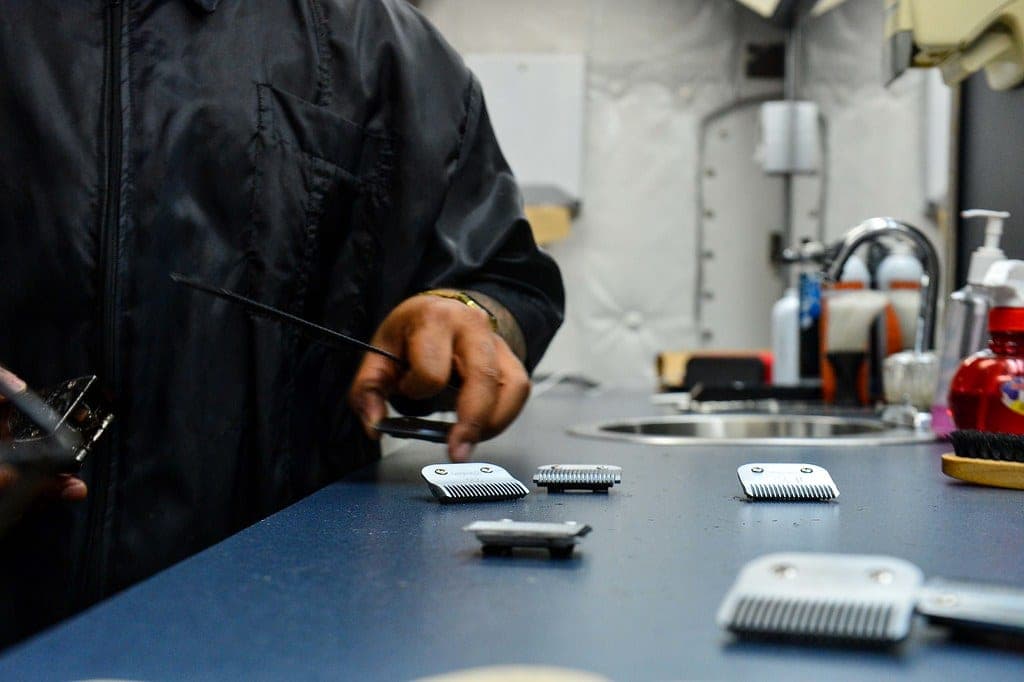
Close-up of clipper blade teeth

Andis UltraEdge detachable blades

A #4F leaves 3/8 inch; a #5F leaves 1/4 inch. Both read as a doodle. A #10 reads as shaved.

The blades that give doodle lengths7.8
5
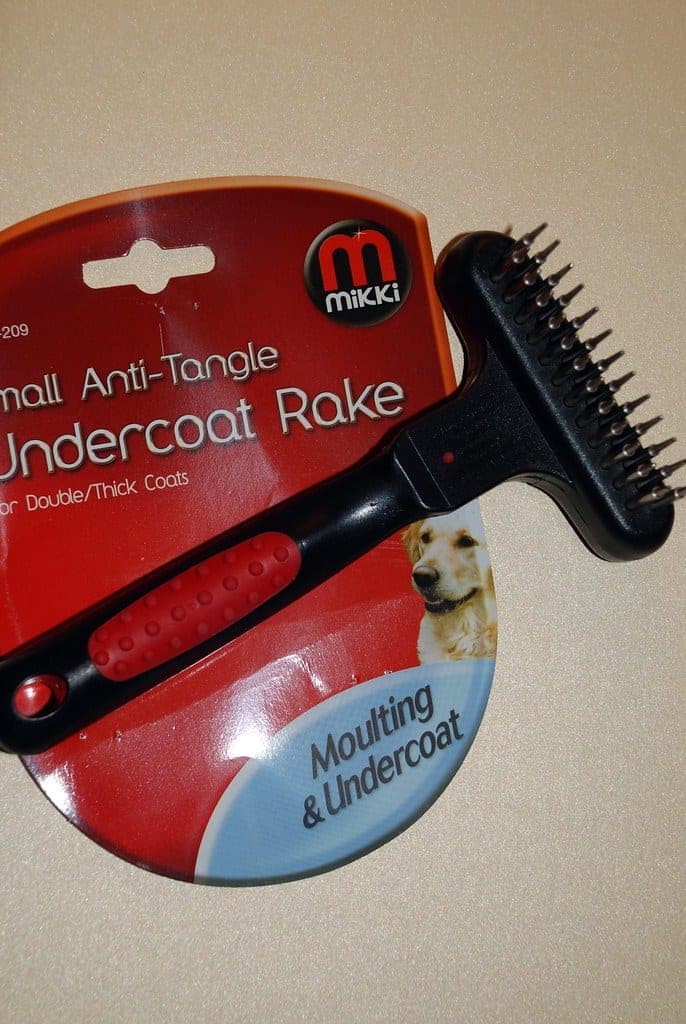
An undercoat rake pulling loose undercoat from a dense coat

Andis 66055 dematting tool (9-blade)

Behind the ears, in the armpits, under the harness. Nine blades open a set mat.

For the patch that got away from you7.4

Scores are our own editorial assessment, not a product rating from reviews or testing. We do not print prices — every button goes to the current one on Amazon. #ad

Is this your dog’s coat?

The short answer

Three checks. Does the coat keep growing rather than reaching a length and stopping? Does the dog shed very little? Is the hair curly, wavy or at least soft and dense rather than harsh? Three yeses means a doodle-type coat: a single growing coat that mats rather than sheds.

The confusing part is that doodle coats vary enormously even within a litter. A labradoodle can have a tight poodle-like curl, a loose wave, or a shedding coat closer to a Labrador’s. Judge by what the coat does, not by what the breed is called. If your dog sheds in volume and has harsh outer hair, read double coat instead.

A dense curly doodle coat photographed close enough to see individual curls interlocking
Each curl grips its neighbors. That is why this coat mats and why brushing has to reach the skin.

Breeds with this coat

Goldendoodle, labradoodle, bernedoodle, sheepadoodle, poodle and bichon frise, plus cockapoos, cavapoos, maltipoos and most other poodle crosses. The same principles apply to all of them; the differences are size and curl tightness.

What this coat needs, and why

A doodle coat grows continuously, so it must be cut — there is no version of owning one where you never clip or scissor. And because the hair does not drop, every shed hair stays in the coat, wraps around its neighbors, and starts a mat. Brushing is not cosmetic on this coat; it is the mechanism that removes shed hair the dog cannot drop.

A deshedding blade. There is no undercoat to remove, so a FURminator-style tool just cuts the coat.

A bladed undercoat rake. Same problem, worse — it thins a single coat permanently.

Bathing a matted coat. Water tightens mats. Get them out first.

Letting it air-dry. The curl sets closed. See dryers for doodles.

The routine

  1. 01

    Line brush two or three times a week

    Part the coat near the skin, brush the exposed layer with a dense slicker, then move the parting up a centimeter and repeat. Work section by section over the whole dog. This is the single habit that decides whether your doodle can be kept long.

  2. 02

    Comb-test every session

    Run a metal comb to the skin in four or five places — behind the ears, armpits, under the collar, hind legs. If it stops, that area is not brushed out. A doodle can look immaculate and be matted underneath.

  3. 03

    Bathe every four to six weeks

    Only once the coat is fully brushed out. Rinse until there is no slip left; residue makes the curl clump as it dries.

  4. 04

    Fluff dry under airflow

    Blow the bulk water out, then dry in sections with the slicker working against the airflow so the hair dries stretched rather than curled. Check it is dry at the skin, not just on top.

  5. 05

    Clip or scissor every four to eight weeks

    A #4F or #5F for a tidy doodle length; longer if you are maintaining a long coat and brushing accordingly. Shears for the face, feet and tail.

  6. 06

    Nails every two to three weeks

    Doodle feet are furry, so hold the foot fur back from a grinder. Trim between the pads monthly.

Frequency, honestly

Coat length you wantBrushingClipping
Long (1/2" and up)Daily to every other dayEvery 6-8 weeks, scissored
Medium (3/8" — a #4F)3x a weekEvery 5-6 weeks
Short (1/4" — a #5F)2x a weekEvery 6-8 weeks
Very short (1/8" — a #7F)WeeklyEvery 8-10 weeks

The relationship is fixed: the longer you keep the coat, the more brushing it takes. Choosing a shorter clip is a legitimate way to buy yourself time.

What to remember

  • This coat mats; it does not shed. Brushing removes hair the dog cannot drop.
  • The brush matters more than the clipper. Pin density is the spec.
  • A metal comb to the skin is the only honest test of whether the coat is brushed out.
  • Never bathe a matted doodle and never let one air-dry.
  • If the coat is felted at the skin, a short clip is the only safe outcome — the coat decided that, not the groomer.
  • Deshedding tools and bladed rakes damage this coat. They are for double coats.

The picks in full

Every pick, in order

01

Buy this first, before any clipper

Chris Christensen Big G slicker brush

Pin density is what reaches the skin through curl. Nothing else prevents matting.

A slicker brush with fine bent pins

Professional slicker brush

Pin density
About 30% more pins than a typical slicker
Sizes
Three
Best for
Doodles, poodles and long-coated breeds

Specs: Chris Christensen — Big G vs Big K slicker brushes

The single most important purchase for a doodle owner, and the one most often made last. A slicker with around 30% more pins than standard, long enough to reach the skin through curl, is what makes line brushing possible. Without it you brush the outer layer and the coat felts underneath while looking fine from above — which is exactly how doodles end up shaved.

Prevents matting10.0
Reaches the skin9.5
Comfort for the dog8.5
Durability9.0
Value7.5
Overall9.1 / 10

What it gets right

  • Pin density is the whole product: more pins means fewer passes through a curly coat
  • The pins are long enough to reach skin on a doodle, which is where matting starts
  • This is the brush that makes line brushing a doodle actually feasible

What it gets wrong

  • Expensive for a brush, by a wide margin
  • Dense pin bed is harder to clean out than a self-cleaning slicker
  • Overkill on a short coat

Who should skip itSkip it if your dog has a short or smooth coat — you will never use the pin density you paid for.

Check price on Amazon

#ad How we earn · We never print a price we cannot verify

02

Best clipper for a doodle

Andis UltraEdge AGC Super 2-Speed

Rotary torque and a vent-free housing: the two things curly coat punishes.

A detachable-blade animal clipper resting on a work surface

Corded detachable-blade clipper

Speeds
3,400 / 4,400 SPM
Motor
Rotary, corded
Blade system
Detachable A5 (UltraEdge / CeramicEdge / ShowEdge)
Cord
14 ft heavy-duty
Weight
17.6 oz
Housing
Vent-free, no cooling fan to clog

Specs: Andis — UltraEdge AGC Super 2-Speed product listing

Doodle coat stalls weak motors and packs fine hair into any fan intake it can find. A rotary two-speed at 3,400 or 4,400 SPM holds its speed in curl, and a housing with no vents has nothing to clog. Add a #4F or #5F and you get a real doodle length in one pass. Corded, and it ships with one blade that is shorter than you want.

Prevents matting6.0
Reaches the skin9.0
Comfort for the dog7.0
Durability9.5
Value8.5
Overall8.7 / 10

What it gets right

  • Two usable speeds rather than one compromise speed — 3,400 SPM for bulk removal, 4,400 for finish work
  • Takes the whole A5 detachable blade range, so one clipper covers every coat length you will ever need
  • The vent-free housing is the reason it survives doodle coats: there is no fan intake for undercoat to pack into
  • 14 ft cord means you are not fighting an extension lead around a grooming table

What it gets wrong

  • Corded, so you work around a cable with a dog that may not stand still
  • Ships with one blade; a doodle or double coat needs at least two more, which is a real added cost
  • Heavier in the hand than a cordless unit over a long session

Who should skip itSkip it if you own one short-coated small dog — this is more clipper than that coat will ever need.

Check price on Amazon

#ad How we earn · We never print a price we cannot verify

Read the full Andis UltraEdge AGC Super 2-Speed review

03

Best dryer for a doodle

Flying Pig Flying One high-velocity dryer

A doodle dried loose curls back into mats. Air at 2,800 FPM dries it stretched.

A forced-air dryer nozzle directed at a damp coat

High-velocity force dryer

Motor
4 HP
Air volume
240 CFM
Air speed
2,800 FPM
Claimed benefit
Cuts drying time by up to 60%

Specs: Finding Dulcinea — Best High-Velocity Pet Dryers for Thick Coats

The step doodle owners skip. Curly hair dries in whatever shape it is in, so a coat left to air-dry sets into tight interlocking curl — matting in slow motion. Dried under airflow with a slicker working against it, the hair dries straight and the coat stays open. 240 CFM at 2,800 FPM is enough to do that across a standard doodle.

Prevents matting9.0
Reaches the skin9.5
Comfort for the dog5.5
Durability8.5
Value8.5
Overall8.5 / 10

What it gets right

  • Real force-dryer output, which is what blows a double coat open instead of merely warming it
  • Enough air to push water out of a Samoyed or Pyrenees in one session
  • The most airflow per dollar in this set

What it gets wrong

  • Loud. All force dryers are, and this is not the quiet one
  • Bulky to store between grooms
  • No heating element, so your bathroom temperature becomes the dog's comfort

Who should skip itSkip it if you have a small, short-coated dog — a towel and ten minutes do the same job.

Check price on Amazon

#ad How we earn · We never print a price we cannot verify

Read the full Flying Pig Flying One high-velocity dryer review

04

The blades that give doodle lengths

Andis UltraEdge detachable blades

A #4F leaves 3/8 inch; a #5F leaves 1/4 inch. Both read as a doodle. A #10 reads as shaved.

Close-up of clipper blade teeth

Detachable A5 blades

#10
1/16 in
#7FC
1/8 in
#5FC
1/4 in
#4FC
3/8 in
#3-3/4FC
1/2 in
#5/8HT
5/8 in
#3/4HT
3/4 in

Specs: Andis UltraEdge / CeramicEdge clipper blade chart

The included blade on almost every clipper is a #10, which takes the coat to 1/16 inch and looks shaved — and that single fact accounts for most first-doodle-groom disappointment. Buying a #4F or #5F changes the result entirely. The blades fit Andis, Oster A5 and Wahl KM bodies, so the purchase survives a change of clipper.

Prevents matting5.0
Reaches the skin8.0
Comfort for the dog8.5
Durability8.5
Value8.5
Overall7.8 / 10

What it gets right

  • The blade range is the whole reason to own a detachable-blade clipper — any length, bought one at a time
  • Fits Andis, Oster A5 and Wahl KM bodies interchangeably
  • Finish-cut (FC) and skip-tooth variants of the same number let you choose bite versus smoothness

What it gets wrong

  • Each blade is a separate purchase and they add up fast
  • Blades dull and need sharpening or replacing — a running cost, not a one-off
  • Blade numbers are counter-intuitive: the bigger the number, the shorter the cut

Who should skip itSkip these if your clipper takes a 5-in-1 adjustable blade — they will not fit it.

Check price on Amazon

#ad How we earn · We never print a price we cannot verify

05

For the patch that got away from you

Andis 66055 dematting tool (9-blade)

Behind the ears, in the armpits, under the harness. Nine blades open a set mat.

An undercoat rake pulling loose undercoat from a dense coat

Bladed dematting tool

Blades
Nine
Best for
Dense mats on small dogs and senior coats
Action
Cuts through the mat rather than pulling it

Specs: Naming Pet — Best Undercoat Rakes

Every doodle owner eventually finds a felted patch, almost always in one of four places: behind an ear, in an armpit, under a collar, or around the sanitary area. A nine-blade dematter cuts a set mat apart with far less pull on the skin than a comb, and it is compact enough for exactly those tight spots. It cuts coat permanently, so it is for mats only.

Prevents matting3.0
Reaches the skin9.0
Comfort for the dog8.0
Durability8.5
Value9.5
Overall7.4 / 10

What it gets right

  • Nine curved blades cut a mat apart with far less pull on the skin than a comb would
  • The right tool for an elderly dog whose skin will not tolerate tugging
  • Compact enough for behind-the-ear and armpit mats

What it gets wrong

  • It cuts coat permanently — the dematted area will look thinner
  • Blades are sharp enough to cut you as well as the mat
  • Not for routine brushing in any sense

Who should skip itSkip it for everyday maintenance — a dematter used weekly will wreck a coat.

Check price on Amazon

#ad How we earn · We never print a price we cannot verify

FAQ

Questions people actually ask

How often should you groom a doodle?

Brush to the skin two to three times a week minimum, daily if you keep the coat long. Clip every four to eight weeks. The clipping interval is flexible; the brushing interval is not.

Why does my doodle keep matting even though I brush it?

Almost always because the brush is not reaching the skin — either the pin density is too low or you are brushing the surface rather than line brushing in sections. Do the comb test: if a metal comb will not pass to the skin, the brushing is not working.

How long does it take to groom a doodle?

A full groom on a standard doodle is two to three hours the first time and 90 minutes once you are practiced, of which the fluff dry is the longest single part. Line brushing between grooms is 15 to 25 minutes a session.

Can I keep my doodle in a long teddy-bear coat?

Yes, if you brush to the skin almost daily. That is the honest trade: long coat is a daily commitment. If you cannot do that, keeping the dog in a 1/4 inch clip is kinder than aiming for long and ending up shaved.

Do doodles need their undercoat raked?

No — most have little or no undercoat. Rakes and deshedding blades do nothing useful on this coat and can thin it permanently.

What blade for a doodle?

A #4F (3/8 inch) for a standard tidy doodle, a #5F (1/4 inch) for a shorter practical clip. Full table on the blade size chart.

How this page was put together

We define the coat problem the tool has to solve, shortlist products currently sold, compare the manufacturers’ documented specifications against what that coat actually needs, and cross-check against published findings from named sources. We do not test these tools on our own dogs under controlled conditions, and we will not say we do. Where a figure comes from a manufacturer, we name them; where it comes from someone else’s testing, we cite them. We print no prices — a stale number is worse than none. Read the full method.

Sources

  1. 01Chris Christensen — Big G vs Big K slicker brushes (pin density)
  2. 02Andis UltraEdge / CeramicEdge clipper blade size chart (PDF)
  3. 03GroomBoard — Best Clippers for Doodles and Goldendoodles