Scores are our own editorial assessment, not a product rating from reviews or testing. We do not print prices — every button goes to the current one on Amazon. #ad
Which coat are you dealing with?
The short answer
Labradoodle coats come in three types: hair (sheds, low maintenance), fleece (wavy, mats moderately) and wool (tight curl, mats readily). Fleece and wool need line brushing to the skin two to three times a week; a hair coat needs a rake and almost no clipping.
A Labradoodle has a doodle coat — curly or wavy, grows without shedding, mats against the skin. Everything below follows from that, and the full set of rules for this coat type, including what will damage it, is on grooming a doodle coat.
The three-coat distinction is real and practical. A hair coat looks and behaves like a slightly shaggy Labrador: it sheds, it has coarse outer hairs, and it needs a rake rather than a slicker. A fleece coat is soft and wavy, sheds very little, and mats at a moderate rate. A wool coat is a tight poodle-like curl that mats readily and needs the most work of the three.
Australian labradoodles, bred as a separate line rather than a first-generation cross, are much more consistently fleece or wool. A first-generation Labrador-poodle cross is the least predictable, and a litter can contain all three.
Check by parting the coat. Two distinct textures with a dense soft layer underneath means the hair coat has a double-coat structure and should be raked, not clipped. One texture that keeps growing means fleece or wool, and it has to be cut.
Labradoodle: Curly or wavy, grows without shedding, mats against the skin.
The breed-specific thing to watch
A hair-coat labradoodle should be raked, not clipped
Owners who assume every labradoodle needs a haircut sometimes clip a hair coat, which behaves like a double coat: the guard hairs come off and the regrowth is softer and prone to matting, creating a problem that did not exist.
If your labradoodle sheds noticeably and has coarse outer hair, treat it as a double coat: rake weekly, use a dryer during a shed, and clip only paw pads and sanitary areas.
The routine
Task
How often
Notes
Line brush (fleece / wool)
2-3x a week
Dense slicker to the skin, then comb-test
Rake (hair coat)
Weekly
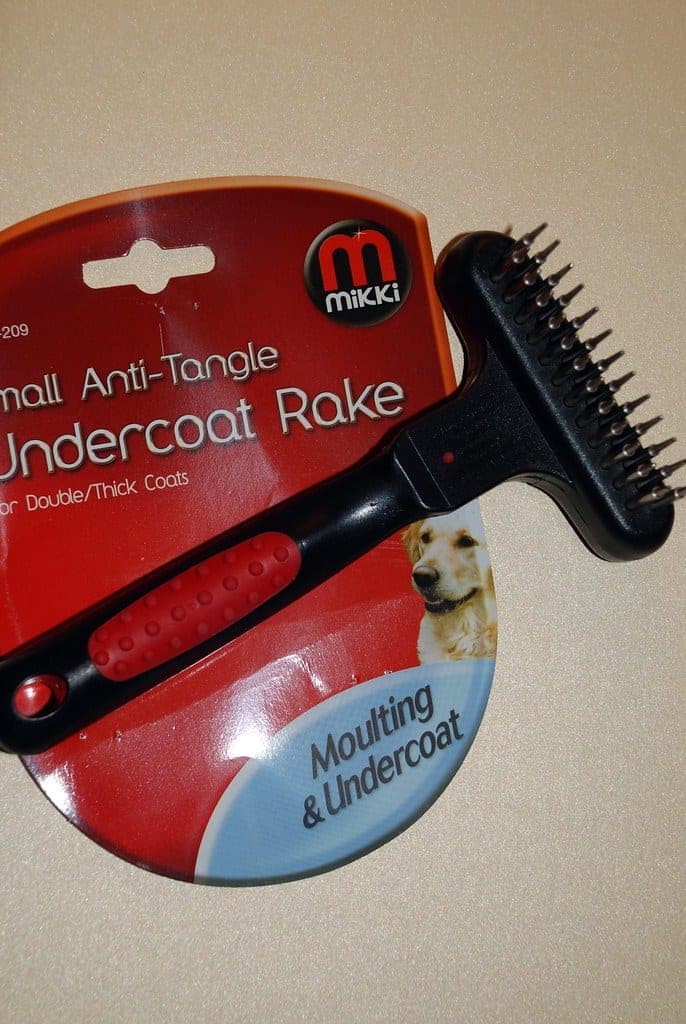
Undercoat rake; no clipper on the body
Bathe
Every 4-8 weeks
Brush out first, always
Fluff dry (fleece / wool)
Every bath
Airflow plus slicker so the curl dries open
Clip (fleece / wool)
Every 6-8 weeks at a #5F or #4F
Not applicable to a hair coat
Face and feet
Every 4-6 weeks
Ball-tipped shears near the eyes
Nails
Every 2-3 weeks
Clear the foot fur from the grinder first
Ears
Weekly check
Hair in the canal on wool coats
Where it goes wrong on this breed
Behind the ears, on every coat type
The beard and mustache on fleece coats — holds food and water
Armpits and groin where a harness sits
The tail, which is often the longest coat on the dog
Between the pads
Time and effort, honestly
A fleece or wool labradoodle is a 90 minute to three hour full groom depending on size and matting, and 15 to 20 minutes of line brushing per session between grooms. A hair coat is a 20 minute rake weekly and no clipping.
The coat page is the one to read in full: grooming a doodle coat. From there the tool roundups cover each purchase in detail, and how to groom a dog at home walks a full session end to end. Other breeds with the same coat are listed on the breed index.
The picks in full
Every pick, in order
01
Fleece and wool coats
Chris Christensen Big G slicker brush
The only brush that reliably reaches the skin through a wool labradoodle coat.
A wool coat is the hardest of the three to keep brushed out, because tight curl closes over itself and hides what is happening at the skin. Pin density and pin length are the two specifications that matter, and this has both. On a fleece coat it is still the right tool and simply takes less work.
Reaches the skin9.5
Suits wool coat10.0
Comfort8.5
Value7.5
Overall9.0 / 10
What it gets right
+Pin density is the whole product: more pins means fewer passes through a curly coat
+The pins are long enough to reach skin on a doodle, which is where matting starts
+This is the brush that makes line brushing a doodle actually feasible
What it gets wrong
−Expensive for a brush, by a wide margin
−Dense pin bed is harder to clean out than a self-cleaning slicker
−Overkill on a short coat
Who should skip itSkip it if your dog has a short or smooth coat — you will never use the pin density you paid for.
A hair-coat labradoodle has a double-coat structure, so the job is removing dead undercoat without cutting the guard hairs. Rotating tines reach the undercoat and have no cutting edge, which makes this the correct and safe tool for that coat type. On a fleece or wool coat it does nothing useful.
Removes undercoat9.0
Guard-coat safety10.0
Suits hair coat10.0
Value9.0
Overall9.3 / 10
What it gets right
+Rotating tines slide through dense undercoat instead of ripping it, so the dog tolerates longer sessions
+Reaches deeper into a double coat than any slicker
+Does not cut, so you cannot thin the guard coat with it
What it gets wrong
−Slower than a bladed deshedder on short coats
−Tines can catch on a genuine mat and need working loose
−Does not finish — you still need a slicker and comb afterwards
Who should skip itSkip it on a short-coated dog — a bladed deshedder does that job far faster.
#adHow we earn · We never print a price we cannot verify
03
Clipping a maintained fleece coat
Wahl Bravura Lithium
Cordless and quiet, with five lengths from one blade. Fine on a coat you keep on top of.
Cordless adjustable-blade clipper
Power
Lithium-ion, cordless (corded operation while charging)
Blade
Adjustable 5-in-1 blade
Cut lengths
Five settings from one blade, no blade swaps
Noise
Quieter than a rotary corded clipper
For a labradoodle that gets line brushed properly and clipped on schedule, a cordless 5-in-1 is genuinely enough and much more pleasant for both of you than a corded pro clipper. The limitation is honest: on a matted wool coat the adjustable blade drags rather than cuts.
Suits a maintained coat8.5
Handling9.5
Length options6.0
Value8.5
Overall8.1 / 10
What it gets right
+The 5-in-1 blade is the honest advantage: five cut lengths without buying or changing a blade
+Cordless, so you can turn the dog instead of walking the cable around it
+Quiet enough that a sound-sensitive dog will usually tolerate it
+Runs plugged in when the battery dies mid-groom
What it gets wrong
−The 5-in-1 blade does not have the bite of a dedicated skip-tooth blade on a matted coat
−Battery runtime is finite — a full standard poodle is more than one charge of careful work
−You cannot fit the wider A5 blade range to it
Who should skip itSkip it if your dog is matted — a 5-in-1 blade will drag through felted coat rather than cut it.
+−How do I tell which labradoodle coat my dog has?
Part the coat and look at the base. Two textures with a dense soft layer beneath, plus visible shedding, is a hair coat. One texture that keeps growing and barely sheds is fleece (wavy) or wool (tight curl).
+−Do labradoodles need haircuts?
Fleece and wool coats do, every six to eight weeks. A hair coat does not need body clipping at all — it needs raking, like a double coat.
+−Best dog grooming tools for labradoodles?
For fleece and wool: a dense slicker, a metal comb, a clipper with a #4F or #5F, and a force dryer. For a hair coat: an undercoat rake and a dryer. Both need nail clippers or a grinder.
+−How often should a labradoodle be bathed?
Every four to eight weeks, always after a full brush-out. Bathing a matted coat tightens the mats.
How this page was put together
We define the coat problem the tool has to solve, shortlist products currently sold, compare the manufacturers’ documented specifications against what that coat actually needs, and cross-check against published findings from named sources. We do not test these tools on our own dogs under controlled conditions, and we will not say we do. Where a figure comes from a manufacturer, we name them; where it comes from someone else’s testing, we cite them. We print no prices — a stale number is worse than none. Read the full method.