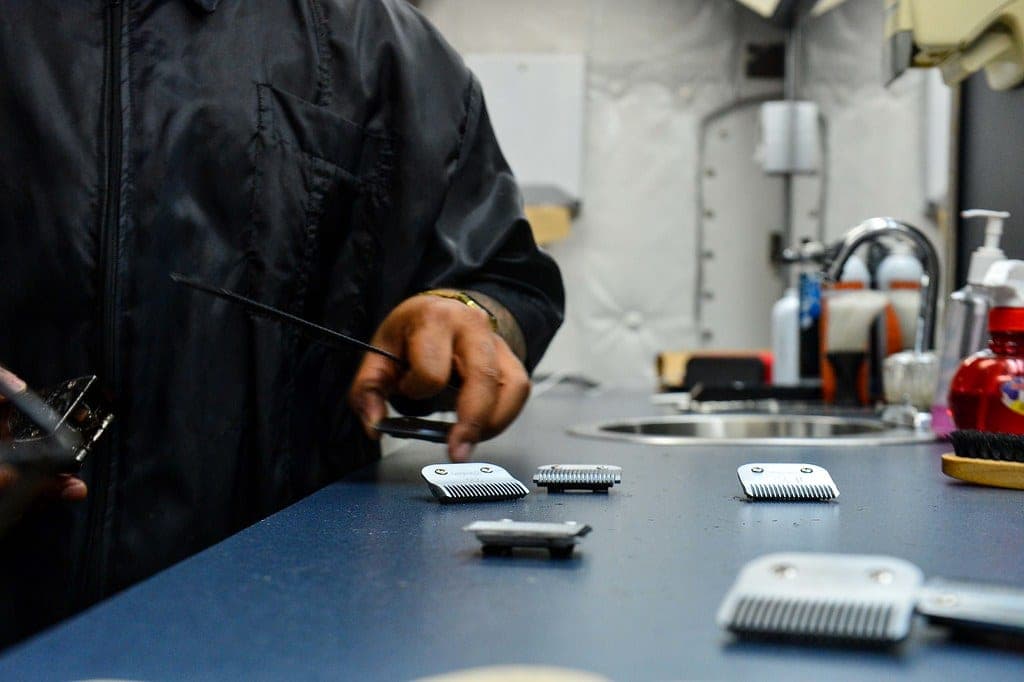
How blade numbers work
The short answer
A clipper blade’s number is its cut length, and the scale runs backwards: a higher number leaves a shorter coat. A #10 leaves roughly 1/16 inch; a #4 leaves roughly 3/8 inch. An “F” suffix means a finish blade, whose teeth are spaced for a smoother cut on a longer length.
This inversion is the single most common cause of an accidentally shaved dog. Someone reasons that a #10 must be longer than a #4 because ten is bigger than four, fits it, and takes their doodle’s body down to a sixteenth of an inch. The numbers are an old barbering convention rather than a measurement, so the only safe approach is to read the chart rather than reason about it.
The chart
Lengths are the manufacturers' published figures; the Andis UltraEdge chart is linked in the sources. Actual length varies slightly with coat angle and blade wear.
Two notes that are not on the chart. A blade cuts shorter when you push it against the skin and longer when you float it over the coat, so technique moves the result by a surprising amount. And a worn blade cuts longer and less cleanly than a new one of the same number — if a #4F suddenly seems to leave more coat and tug, it needs sharpening rather than replacing.
What F means, and when it matters
A plain blade (a #4) and a finish blade (a #4F) leave the same length. The difference is tooth spacing: the F blade’s teeth are closer together, so it leaves a smoother surface and is less likely to show tracking lines. The trade is that the finer spacing clogs faster in a dense coat. For home use on a doodle, F blades are worth it — the finish is noticeably better and tracking lines are the most common complaint about a home groom.
Which blade for which job
What to actually buy
A sensible home kit is two blades, not twelve: a #10 and a #4F. That covers sanitary work, mats and the belly at the short end, and body coats at the long end, which is nearly everything a home groomer does. Add a #7F if you clip short in summer. Everything else on the chart exists for professionals doing breed-standard work or for surgical prep.
The alternative is one short blade plus a comb set, which gets you a wide range of lengths for much less money and works well on straight or wavy coat. The full argument is on blades versus guard combs, and the picks are on clipper blades.
Blade heat is a burn risk, and it is about the blade, not the clipper
A blade reaches skin-burning temperature long before the clipper body feels warm in your hand, so your hand is not a warning system. The thinner the blade, the faster it heats — a #10 and a #15 get hot much faster than a #4F. Touch the blade to your own forearm every couple of minutes: if you cannot hold it there comfortably, stop, swap to a second blade or let it cool.
Oil across the teeth every ten minutes of running time, not once at the start. See why clippers overheat and preventing clipper burn.
Blade compatibility
Steel A5 blades are a shared standard: Andis, Wahl and Oster detachable-blade clippers all take the same blades, so your blade collection is portable between brands and survives a clipper upgrade. That is a strong reason to buy into the detachable-blade category rather than a fixed-head machine with proprietary plastic combs. Snap-on guide combs are much less reliably cross-compatible — check the fit before buying another brand’s set.
What to remember
- →Higher number = shorter cut. Read the chart; do not reason about the numbers.
- →A #10 is a sanitary blade, not a body blade. This is the mistake that shaves dogs.
- →F means finer tooth spacing and a smoother finish at the same length — worth it at home.
- →A two-blade kit (#10 and #4F) covers almost all home grooming.
- →A5 blades fit Andis, Wahl and Oster alike, so the blades outlive the clipper.
- →Blade heat burns before the clipper feels warm. Test it on your own forearm.
How this page was put together
We define the coat problem the tool has to solve, shortlist products currently sold, compare the manufacturers’ documented specifications against what that coat actually needs, and cross-check against published findings from named sources. We do not test these tools on our own dogs under controlled conditions, and we will not say we do. Where a figure comes from a manufacturer, we name them; where it comes from someone else’s testing, we cite them. We print no prices — a stale number is worse than none. Read the full method.