Skip to content
Clip & Coat

Guides

Why Dog Clippers Leave Lines (Tracking)

Stripes down the flank after a home groom are the most common complaint and the most fixable. Four of the five causes cost nothing to fix.

By Brijon M.
A clipper traveling along a dog's coat in a single pass

The short answer

The short answer

Tracking lines mean the blade cut at different heights on adjacent passes. Five causes: a dull blade, inconsistent pressure, passes that do not overlap, a coat that is damp or dirty at the skin, and a plain blade where a finish blade belongs. Four of the five are free to fix.

The five causes, in the order to check them

CauseThe tellFix
Dull bladeIt also pulls hair and runs hot; the lines appeared on a blade that used to be fineSharpen or replace. No technique compensates for this
Damp or dirty coatLines all over rather than in bands; coat felt clumpyBathe, then dry to the skin. Clip clean dry coat only
Inconsistent pressureLines follow the direction you worked, varying across the bodyBlade flat, steady walking pace, same contact throughout each pass
Passes not overlappingEvenly spaced ridges the width of the bladeOverlap each pass by about a third of the blade width
Plain blade instead of a finish bladeA faint, uniform texture rather than hard stripesUse the F version of the same number

Overlapping is the technique fix

The most common self-inflicted version of this is laying passes edge to edge, like mowing a lawn. A clipper blade does not cut perfectly evenly to its outer edge, so the boundary between two touching passes ends up slightly longer than the middle of either — and twenty of those in a row is a visible stripe pattern. Overlap each pass by roughly a third of the blade width and the boundaries disappear.

Pressure is the other half. A blade pushed into the coat cuts shorter than a blade floated over it, so if your pressure varies as your arm extends, the cut height varies with it. Work in short passes you can keep consistent rather than long sweeps that start firm and end light, and move your feet rather than stretching.

A dense coat being parted to check it is clean and dry to the skin
Check the coat at skin level before clipping. Damp or clumped coat produces lines no blade can fix.

Curly coats are harder, and that is not your fault

A curly doodle coat does not lie in a consistent direction, so it does not present consistently to the blade. Lines are genuinely harder to avoid there, and the two things that help most are force-drying the coat straight before clipping, and brushing it out thoroughly so the hairs stand up rather than clumping. A finish blade helps; a comb set makes it worse, because combs have to gather coat and curly coat resists being gathered — see blades versus guard combs.

Fixing lines that are already there

  1. 01

    Brush the area out

    Lift the coat with a slicker so the hairs stand up and the actual lengths are visible rather than hidden by lie.

  2. 02

    Go back over at the same length

    Same blade, light pressure, passes running at right angles to the lines. Crossing the direction evens the heights out.

  3. 03

    Do not drop to a shorter blade

    Shortening everything to the lowest point of the lines works, and it also shaves a dog that did not need shaving. Cross-pass first.

  4. 04

    Blend with scissors if a band persists

    A straight scissor cut into a soft edge removes a hard line that a clipper is reintroducing.

  5. 05

    Accept the coat will grow

    A mild tracking pattern is invisible within two or three weeks. It is a cosmetic problem with a deadline.

A hard, raised, red line — especially a straight one in an armpit, groin or flank — may be clipper burn rather than a tracking line. Burn is about heat and skin, not length, and it does not grow out. If a line is red, warm or sore to the touch rather than just visible, read preventing clipper burn and consider a vet.

What to remember

  • Lines mean adjacent passes cut at different heights.
  • Check the blade first: a dull blade produces lines no technique can fix.
  • Clip clean, dry, brushed coat. Damp coat clumps and clumped coat lines.
  • Overlap every pass by about a third of the blade width.
  • Use the F version of a blade for a smoother finish at the same length.
  • Fix existing lines by cross-passing at the same length, never by going shorter.

The picks in full

Every pick, in order

01

A finish blade, which is the equipment half of the fix

Andis UltraEdge detachable blades

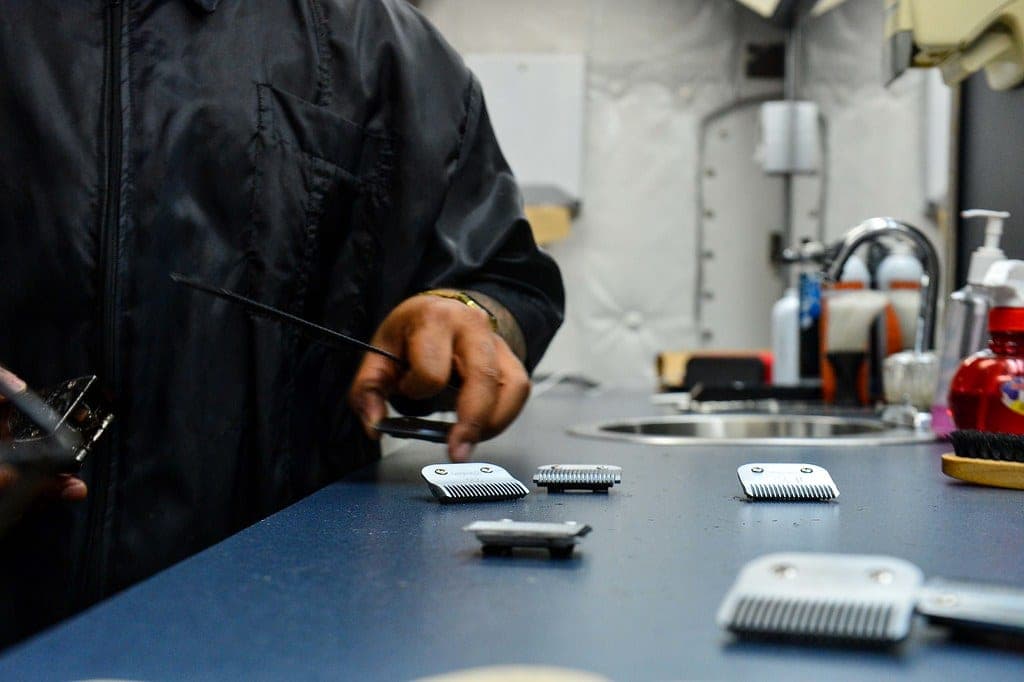
An F-series blade's finer tooth spacing leaves a smoother surface at exactly the same length.
Close-up of clipper blade teeth

Detachable A5 blades

#10
1/16 in
#7FC
1/8 in
#5FC
1/4 in
#4FC
3/8 in
#3-3/4FC
1/2 in
#5/8HT
5/8 in
#3/4HT
3/4 in

Specs: Andis UltraEdge / CeramicEdge clipper blade chart

A #4 and a #4F cut the same length; the F blade's teeth sit closer together and leave a visibly smoother surface, which is why it is the blade to own if tracking lines are your complaint. A sharp blade is the other half - a dull blade leaves lines no technique can remove, and these are sharpenable rather than disposable.

Finish quality9.5
Cut consistency9.0
Durability9.0
Cross-brand fit9.5
Value7.5
Overall9.0 / 10

What it gets right

  • The blade range is the whole reason to own a detachable-blade clipper — any length, bought one at a time
  • Fits Andis, Oster A5 and Wahl KM bodies interchangeably
  • Finish-cut (FC) and skip-tooth variants of the same number let you choose bite versus smoothness

What it gets wrong

  • Each blade is a separate purchase and they add up fast
  • Blades dull and need sharpening or replacing — a running cost, not a one-off
  • Blade numbers are counter-intuitive: the bigger the number, the shorter the cut

Who should skip itSkip these if your clipper takes a 5-in-1 adjustable blade — they will not fit it.

Check price on Amazon

#ad How we earn · We never print a price we cannot verify
02

The damp-coat cause, which no blade fixes

Flying Pig Flying One high-velocity dryer

Drying a coat to the skin removes the cause most owners never suspect.

A forced-air dryer nozzle directed at a damp coat

High-velocity force dryer

Motor
4 HP
Air volume
240 CFM
Air speed
2,800 FPM
Claimed benefit
Cuts drying time by up to 60%

Specs: Finding Dulcinea — Best High-Velocity Pet Dryers for Thick Coats

A coat that is damp at skin level clumps, and a clumped coat presents unevenly to the blade - which produces lines regardless of how good your blade or your technique is. Force-drying to the skin is the only reliable way to eliminate that, and on a curly coat it also straightens the hair so the blade meets it consistently.

Solves the problem8.5
Airflow9.5
Noise5.0
Storage footprint6.0
Value9.5
Overall8.2 / 10

What it gets right

  • Real force-dryer output, which is what blows a double coat open instead of merely warming it
  • Enough air to push water out of a Samoyed or Pyrenees in one session
  • The most airflow per dollar in this set

What it gets wrong

  • Loud. All force dryers are, and this is not the quiet one
  • Bulky to store between grooms
  • No heating element, so your bathroom temperature becomes the dog's comfort

Who should skip itSkip it if you have a small, short-coated dog — a towel and ten minutes do the same job.

Check price on Amazon

#ad How we earn · We never print a price we cannot verify

Read the full Flying Pig Flying One high-velocity dryer review

FAQ

Questions people actually ask

Will the lines grow out?

Yes — a mild tracking pattern is invisible within two or three weeks on a growing coat. That is worth remembering before you take everything shorter trying to even it out, because the shave does not grow back nearly as fast.

Do I need to clip against the coat to get a smooth finish?

No, and you should not while you are learning. Clipping against the coat cuts shorter than the blade number and magnifies every inconsistency in pressure — it is a technique for finishing a coat you already understand, not a fix for lines.

Why does my clipper leave lines only on the back legs?

Because coat direction changes most there, and so does your arm’s reach and angle. Move your feet so you are working square to the area rather than stretching across the dog, and use shorter passes.

How this page was put together

We define the coat problem the tool has to solve, shortlist products currently sold, compare the manufacturers’ documented specifications against what that coat actually needs, and cross-check against published findings from named sources. We do not test these tools on our own dogs under controlled conditions, and we will not say we do. Where a figure comes from a manufacturer, we name them; where it comes from someone else’s testing, we cite them. We print no prices — a stale number is worse than none. Read the full method.

Sources

  1. 01Ryan's Pet Supplies — Andis UltraEdge blade size chart (PDF)
  2. 02GroomBoard — clippers professional groomers use