A doodle is the one coat that punishes you twice: it mats against the skin while the surface looks fine, and it does not stop growing. Six tools handle both.
27 mm stainless pins on a flexible cushion pad, with a published 30% more pins than the maker's Big K. Pin length is what decides whether you brushed the coat or the top of it.
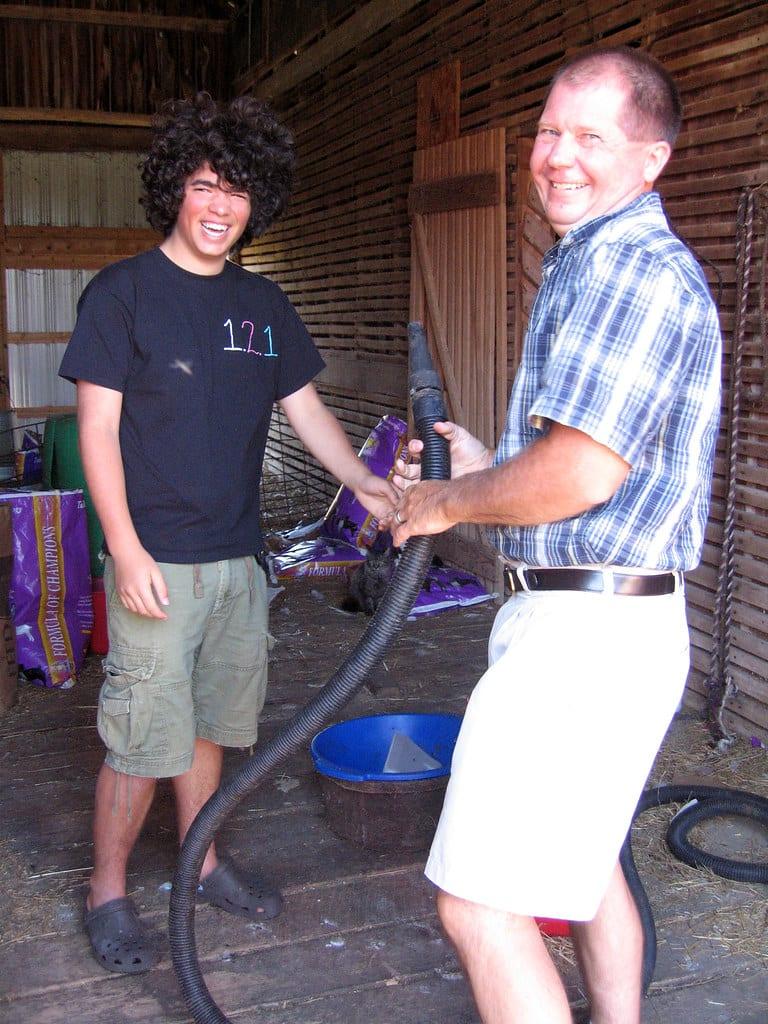
A 4 HP force dryer at a published 240 CFM. On a doodle it does two jobs: it prevents mats as the coat dries, and it dries the coat straight enough to clip evenly.
Four 440C Japanese-steel shears — straight, curved, thinner and chunker — in a case. The thinner is the one that rescues a clipper line you cannot blend.
Last: the face, the topknot and blending out clipper lines
Scores are our own editorial assessment, not a product rating from reviews or testing. We do not print prices — every button goes to the current one on Amazon. #ad
The short answer
The short answer
Buy in this order: a detachable-blade clipper and a set of guard combs together, then a long-pinned slicker and a steel comb, then a force dryer, then shears. The clipper is the only tool that addresses what a doodle coat actually does, and the comb is the cheap one that stops a shave-down.
This page is for you if
You own a Goldendoodle, Labradoodle, Bernedoodle, Sheepadoodle or poodle cross, you are tired of paying for a haircut every six weeks, and you want the kit that does the whole job rather than a 20-piece box.
You are on the wrong page if
Your dog has a long coat you keep long rather than cut — a Maltese, a Yorkie, a coated Collie. The tools differ and the routine differs: the long-coat kit is the page for that.
Why a doodle needs a different kit from every other dog
Most grooming kits are sold for one of two dogs. A shedding double coat, where the job is pulling dead undercoat out. Or a short coat, where the job is barely a job. A doodle is neither, and it combines the two hardest properties a coat can have.
It does not shed, so the dead hair stays in. A Labrador drops its loose coat on your floor. A doodle keeps it, woven into the live coat, where it tangles against the curl and felts. That is why a doodle mats and a Labrador does not.
It does not stop growing. A double coat reaches its length and stops. A doodle coat keeps extending, so even a perfectly brushed one needs cutting on a schedule. There is no version of doodle ownership that does not involve a haircut every six to eight weeks, at a groomer or at home.
And it hides the problem. The felting happens in the half inch against the skin, under a layer that still looks glossy and feels soft. This is the cruel part, and it is why so many doodle owners are blindsided by a shave-down: they were brushing, honestly and often, and the brush never reached far enough for it to count.
If you are not certain this describes your dog, the doodle coat page has the three-check test — doodle crosses vary enormously and a flat-coated F1 is a different grooming job from a tight-curled F1B.
The criteria these six were chosen on
A doodle kit gets judged on different things from a general grooming kit, and most of the usual criteria — motor speed, piece count, brand — barely matter here.
Criterion
Why it decides a doodle kit
What fails it
Clog resistance
Fine curly undercoat packs a cooling-fan intake solid and kills the clipper. A vent-free design has no intake to clog.
Home clippers with fan cooling — the single most common doodle clipper failure
Cut length you can choose
Almost nobody wants a doodle at blade length. Guard combs over the blade are how you keep half an inch instead of an eighth.
Fixed-blade kits; any clipper that will not take attachment combs
Pin length on the brush
The coat mats at the skin. A brush that stops short of the skin cannot clear the layer that matters.
Short-pinned slickers, rubber curries, most boxed-kit brushes
Verification
You cannot see or feel a forming mat under clear topcoat, and clipping an uncombed coat jams the blade.
Any brush used without a comb
Drying behavior
A curly coat dried by towel dries matted, and a curled coat cannot be clipped evenly — the blade cuts curl tops.
Towels, human hair dryers, air drying
Scissors for the face
A clipper on a doodle face gives the shaved-muzzle look. The teddy-bear face is scissor work, plus a thinner for clipper lines.
Kit scissors with no real edge; a curved shear alone with no thinner
Each pick below answers one of these. Nothing was added to make the list longer.
Buy them in this order
You do not need all six at once, and the order matters because two of them are a single purchase in practice.
First, together: the clipper and the guard combs. Buying the clipper alone is the classic doodle mistake — you fit the blade it came with, discover it cuts far shorter than you intended, and either shave the dog or stop. The combs are a fraction of the clipper’s price and they are what makes the clipper produce the coat you wanted.
Second, together: the brush and the comb. Also one purchase in practice, because the brush does the work and the comb is the only thing that can tell you the work was done. If the budget is tight, a mid-priced slicker plus a cheap steel comb beats an expensive brush on its own, every time.
Third: the dryer — but only if you bathe at home. If the dog goes out for baths, skip it. If you bathe at home, it is the purchase that turns a patchy home clip into an even one, which is usually the complaint that sends people back to the groomer.
Last: the shears. You can clip a body before you can scissor a face, and most owners should. Doing the body at home and paying a groomer for a face tidy is a perfectly sensible halfway house for the first year.
The face is scissor work on a doodle. A body blade here produces exactly the look owners are trying to avoid.
The mistake that costs people the coat
It is worth being specific about the sequence that goes wrong, because it is almost always the same one. The dog gets brushed on the surface for a few weeks. A mat forms at the skin where nothing has reached. The owner decides to clip, puts a guard comb on, and the comb rides straight over the felted section instead of cutting it — guard combs skip on any coat that is not fully brushed out. The clipper jams, the dog flinches, and the session ends with a half-done dog.
The order that works is the opposite: comb first, clip second. If the comb will not pass from skin to tip, that section is not ready for a clipper at any length. And if the comb will not pass between the mat and the skin at all, you are past the point where home tools help — how to clip matted dog hair covers where the line between a home job and a groomer’s job sits, and it is a line worth respecting.
The technique that actually clears a doodle is line brushing: part the coat flat, brush the exposed line from skin outward, drop the parting a quarter inch, repeat up the dog. It is slower than brushing the surface and it is the only method that reaches what matters. Our line-brushing walkthrough uses a double coat for the photographs, but the method is identical on a doodle.
Do not buy a deshedding blade for a doodle
FURminator-style bladed deshedders are undercoat tools for dogs that shed. A doodle does not shed meaningfully, so there is no loose undercoat for the blade to lift — it cuts live coat instead, thinning it permanently and doing nothing about the matting you bought it for. FURminator versus a slicker brush sets out which coats each belongs on.
What this kit costs against what you are paying now
We publish no prices on this site — there is no verified price feed connected, so every buy link above reads “check price on Amazon” rather than printing a figure that goes stale. What is worth saying is where these sit relative to one another, because it changes the buying order.
The clipper and the dryer are the two large items, in the bracket where a tool becomes equipment. The professional brush is expensive for what it is. The guard combs and the steel comb are both trivial next to everything else, which is precisely why skipping them is such a bad trade. The shear set is a serious outlay and the most deferrable.
Against that: a doodle groom is one of the more expensive appointments in the trade, it recurs every six to eight weeks, and the arithmetic over a three-year horizon is not close. What grooming costs versus doing it yourself works it through properly, including the tool spend you will not get back in year one.
Where to go deeper on each tool
This page names one pick per job. If you want the field rather than the pick, each category has its own ranking: clippers for doodles compares five including the cordless and budget routes, dryers for doodles covers the airflow question, and grooming shears ranks shears on edge quality. For the routine rather than the kit, the Goldendoodle routine and how to trim a doodle face are the two pages doodle owners use most.
What to remember
What to remember
→A doodle coat does not shed and does not stop growing. It has to be cut, not just maintained.
→Buy the clipper and the guard combs together — the clipper alone cuts far shorter than you want.
→The coat mats at the skin under topcoat that still looks fine. Pin length is the spec that matters.
→The cheapest tool here is the comb, and it is the one that prevents a shave-down.
→Comb first, clip second. Guard combs skip over felted coat and jam the blade.
→A curled coat cannot be clipped evenly — force-dry it straight first, or expect a patchy finish.
→The face is scissor work. A body blade on a doodle muzzle gives the look owners hate.
→No deshedding blade. A doodle has no loose undercoat for it to lift, so it cuts live coat.
The picks in full
Every pick, in order
01
Buy first: the clipper, because this coat has to be cut
Andis UltraEdge AGC Super 2-Speed
Corded, 3,400 and 4,400 SPM, the full detachable A5 blade range, and a vent-free housing with no fan intake for curly undercoat to pack into.
Everything else on this list is maintenance. This is the tool that does the thing a doodle actually needs, which is a haircut every six to eight weeks for the rest of its life. The vent-free housing is the specification that matters for this coat specifically: fine curly undercoat finds any cooling-fan intake, packs it solid, and the clipper dies — it is why cheaper clippers fail on doodles and survive Labradors. Two speeds give you a bulk pass and a finish pass, and the A5 blade mount means every length is available one blade at a time. It is corded, which is a genuine nuisance around a 60 lb dog that will not stand still, and it ships with one blade shorter than you want.
Cuts a dense curly coat9.5
Heat and clog resistance9.0
Length flexibility9.5
Convenience6.5
Value over 3 years9.0
Overall9.0 / 10
What it gets right
+Two usable speeds rather than one compromise speed — 3,400 SPM for bulk removal, 4,400 for finish work
+Takes the whole A5 detachable blade range, so one clipper covers every coat length you will ever need
+The vent-free housing is the reason it survives doodle coats: there is no fan intake for undercoat to pack into
+14 ft cord means you are not fighting an extension lead around a grooming table
What it gets wrong
−Corded, so you work around a cable with a dog that may not stand still
−Ships with one blade; a doodle or double coat needs at least two more, which is a real added cost
−Heavier in the hand than a cordless unit over a long session
Who should skip itSkip it if you own one short-coated small dog — this is more clipper than that coat will ever need.
This is the pick doodle owners most often do not know they need, and skipping it is the single most common reason a first home groom ends with a dog that looks shaved. A bare A5 blade cuts short — the popular ones take a doodle down to between an eighth and three eighths of an inch, which is far shorter than the fluffy half-inch teddy-bear look almost every doodle owner actually wants. Guard combs sit over the blade and lift the coat to a set height, so you get length instead of skin. They also make an even finish much easier on a curly coat, because the comb rides the body shape. The cost is real: they clog and skip badly on any coat that is not fully brushed out first, plastic sets snap, and you still cannot do close work around a face or between toes with one on.
Cuts a dense curly coat7.0
Heat and clog resistance4.0
Length flexibility9.5
Convenience8.0
Value over 3 years9.5
Overall8.4 / 10
What it gets right
+A graded run of eight lengths off one blade, which is the cheapest honest way to own a range of cut lengths
+Color-coded, so the length you used last time is findable rather than guessed
+Spring-mounted steel combs stay on the blade instead of pinging off mid-stroke
+Easier to get an even finish on a fluffy coat than a bare short blade
What it gets wrong
−They clog and skip on any coat that is not fully brushed out first
−You cannot get close work — faces and feet still need a bare blade or shears
−Andis states the compatibility two ways on one page: #10, #15 and #30 in the feature bullet, #30 and #10 in the spec table
−PetSmart's listing calls the set stainless steel in the copy and fills its Material field with Plastic, so check what you are getting at the price you are paying
Who should skip itSkip them if your dog mats between grooms — combs ride over felted coat instead of cutting it.
#adHow we earn · We never print a price we cannot verify
03
The brush that reaches the skin on a curly coat
Chris Christensen Big G slicker brush
27 mm stainless pins on a flexible cushion pad, with a published 30% more pins than the maker's Big K. Pin length is what decides whether you brushed the coat or the top of it.
Professional slicker brush
Pins
Stainless steel, 27 mm long
Pin density
About 30% more pins than the maker's Big K brushes
Pad
Flexible cushion pad
Sizes
Large (3-3/4" x 3-3/4" head, 8" long), Medium (2-3/8" x 3-3/4", 7-3/8"), Baby G (2-3/8" x 2-3/8", 7-3/8")
A doodle coat mats in the half inch nearest the skin, under a surface layer that still looks and feels fine, which is why owners who brush faithfully are still told the dog has to be clipped off. A short-pinned slicker never reaches that layer. The Big G's 27 mm pins do, and the published pin density means fewer passes to clear each parted line, which is what makes line-brushing a whole doodle a job you finish rather than abandon at the second shoulder. It is the most expensive item here relative to what it is, it has no self-cleaning mechanism so you pull the coat out of a dense pin bed by hand, and it is completely wasted on a short or smooth coat. It is also on our long-coat kit, because it is the right answer there too.
Reach to skin9.5
Mat prevention9.5
Clearance per pass9.0
Convenience6.0
Value over 3 years7.5
Overall8.7 / 10
What it gets right
+Pin density is the whole product: more pins means fewer passes through a curly coat
+The pins are long enough to reach skin on a doodle, which is where matting starts
+This is the brush that makes line brushing a doodle actually feasible
What it gets wrong
−Expensive for a brush, by a wide margin
−Dense pin bed is harder to clean out than a self-cleaning slicker
−Overkill on a short coat
Who should skip itSkip it if your dog has a short or smooth coat — you will never use the pin density you paid for.
The cheapest thing on this page and the one that changes the outcome most, because a brush cannot tell you whether it worked. A slicker glides over a forming mat exactly as it glides through clear coat, so brushing alone gives you no feedback at all. A comb cannot glide: it stops. Run it from skin outward in sections after brushing, and the first time it stops you have found a mat while it is still a tangle rather than a vet conversation. It is also the test that tells you whether the coat is safe to clip, which matters because clipping an uncombed doodle is how blades jam and dogs get frightened. The honest limits: no cushioned handle, so a long session on a big coat is hard on the fingers, and average tooth length means it will not reach skin through the thickest doodle coat — the 10 in version covers more ground there.
Honesty of the check10.0
Mat prevention8.0
Reach to skin7.0
Convenience8.5
Value over 3 years10.0
Overall8.5 / 10
What it gets right
+The coarse half opens tangles and the fine half checks your work, so one comb does both jobs
+Costs less than a takeaway and will outlive several plastic brushes
+7.5 in is the length that suits most dogs — long enough to reach, short enough to control one-handed
+Steel teeth with a smooth taper, so they part the coat instead of snagging it
What it gets wrong
−No cushioned handle — a long session on a big coat is hard on the fingers
−Tooth length is average, so it will not reach the skin through a thick doodle coat
−Unbranded lookalikes at the same price often have rough tooth tips, so buy the real one
Who should skip itSkip it if your dog is a heavy-coated giant breed — the 10 in version covers more ground per stroke.
#adHow we earn · We never print a price we cannot verify
05
The tool that makes an even clip possible
Flying Pig Flying One high-velocity dryer
A 4 HP force dryer at a published 240 CFM. On a doodle it does two jobs: it prevents mats as the coat dries, and it dries the coat straight enough to clip evenly.
Doodle owners buy this last and it belongs third or fourth. Two things make it specific to this coat rather than a luxury. The first is that a towel-dried curly coat dries matted — toweling works the hairs into each other and the coat sets that way. The second is that you cannot clip a curly coat evenly while it is still curled: the blade cuts the top of each curl and leaves the hair under it long, which is where patchy, lumpy home clips come from. Force air straightens and separates the coat so the clipper meets an even surface. At a published 240 CFM this has real output rather than hair-dryer output. It is loud, it is bulky to store, and it has no heating element, so your bathroom temperature becomes the dog's comfort. Note too that published air-speed figures for it disagree between sellers, so treat any single FPM number on a listing as unverified.
Drying speed9.0
Mat prevention9.0
Prep for an even clip9.5
Convenience4.5
Value over 3 years8.5
Overall8.5 / 10
What it gets right
+Real force-dryer output, which is what blows a double coat open instead of merely warming it
+Enough air to push water out of a Samoyed or Pyrenees in one session
+The most airflow per dollar in this set
What it gets wrong
−Loud. All force dryers are, and this is not the quiet one
−Bulky to store between grooms
−No heating element, so your bathroom temperature becomes the dog's comfort
Who should skip itSkip it if you have a small, short-coated dog — a towel and ten minutes do the same job.
Last: the face, the topknot and blending out clipper lines
Chris Christensen Classic Series shear set
Four 440C Japanese-steel shears — straight, curved, thinner and chunker — in a case. The thinner is the one that rescues a clipper line you cannot blend.
Four-shear grooming set
Contents
Straight, curved, thinner and chunker
Steel
440C Japanese steel
Case
Included
A doodle's face is the part a clipper should not do, and it is the part everyone judges. Clipping a doodle face with a body blade produces the shaved-muzzle look owners hate; the teddy-bear face is scissor work, and it needs a curved shear for the round shape and a thinner to soften the edges. The thinner is also the fix for the mistake every home groomer makes at least once: a visible line where two clipper passes met at different heights. A thinner breaks that line up instead of cutting a deeper one. This is a serious outlay for a first year and four shears is more than most owners need — if the budget is tight, one curved ball-tip shear plus a thinner covers 90% of it, and our shear picks cover that route. 440C edges are also unforgiving if you drop them.
Face and topknot work9.5
Blending clipper lines9.5
Safety near eyes8.0
Convenience7.0
Value over 3 years6.5
Overall8.3 / 10
What it gets right
+The four shears cover genuinely different jobs — this is not four versions of the same tool
+440C steel takes and holds a real edge, which is what separates a shear from scissors
+The thinner is what rescues a clipper line you cannot blend out
What it gets wrong
−A serious outlay for a first-time home groomer
−Four shears is more than most owners need in year one
−Japanese-steel edges are unforgiving if you drop them
Who should skip itSkip the full set if you clip rather than scissor — buy one curved shear and a thinner instead.
#adHow we earn · We never print a price we cannot verify
FAQ
Questions people actually ask
+−What grooming tools do I need for a doodle?
Six cover the whole job: a detachable-blade clipper, a set of guard combs so you can keep length rather than clipping to the skin, a long-pinned slicker brush, a steel comb to check the brushing, a force dryer if you bathe at home, and shears for the face. The clipper and combs are one purchase; so are the brush and comb.
+−Can I groom a doodle myself?
Yes, and a lot of owners do the body at home and pay a groomer for the face in the first year, which is a sensible split. What you cannot do at home is rescue a coat that has already felted to the skin — that means working a blade against skin you cannot see, and it is a groomer’s job.
+−What length should I clip a doodle to?
Most owners want something around half an inch, which a bare blade will not give you — the common A5 blades cut much shorter. That length comes from a guard comb over the blade. Leaving it longer looks better and mats faster, so the honest answer depends on how often you are willing to brush.
+−How often does a doodle need brushing?
Daily or close to it for most doodle coats, and the method matters more than the frequency: a thorough line-brush to the skin a few times a week prevents far more matting than a surface brush every day. Check with a comb afterwards — if the comb stops, the brushing is not done.
+−Why does my doodle look patchy after I clip it?
Usually because the coat was still curled when you clipped it. A clipper cuts the top of each curl and leaves the hair beneath it long, which reads as lumpy. Force-drying the coat straight before clipping is the fix. The other common cause is a visible line where two passes met at different heights, which a thinning shear breaks up.
+−Is this the same as your long-haired dog tool kit?
No, and the difference is whether the coat gets cut. A long single coat is kept at length, so that kit is brush-led with no body clipper. A doodle coat has to be cut on a schedule, so this kit is clipper-led. Two picks appear on both pages because they are genuinely the right answer for both coats.
How this page was put together
We define the coat problem the tool has to solve, shortlist products currently sold, compare the manufacturers’ documented specifications against what that coat actually needs, and cross-check against published findings from named sources. We do not test these tools on our own dogs under controlled conditions, and we will not say we do. Where a figure comes from a manufacturer, we name them; where it comes from someone else’s testing, we cite them. We print no prices — a stale number is worse than none. Read the full method.