Skip to content
Clip & Coat

Compare

FURminator vs Slicker Brush

This one is decided by a single question: does your dog shed, or does it mat? The two problems need opposite tools and the packaging will not tell you which.

By Brijon M.
A slicker brush beside a deshedding blade

The short answer

The short answer

If your dog sheds, you want a deshedding tool: the problem is loose hair sitting in the coat. If your dog’s coat keeps growing and mats, you want a slicker brush: the problem is hair tangling and felting against the skin. A deshedding blade on a doodle achieves nothing and cuts coat; a slicker on a shedding Husky is simply slow.

One question decides it

Part your dog’s coat on the side of its body and ask what happens to shed hair. On a shedding coat it falls out — onto your floor, your sofa and your clothes. On a growing coat it stays in, wrapping around the hairs still attached and felting into mats that work their way to the skin. Those are opposite problems and the tools are not interchangeable.

Your dogProblemTool
Doodle, poodle, BichonMats — hair stays in the coatSlicker brush plus a steel comb
Yorkie, Maltese, Shih TzuTangles in long fine hairSlicker brush, gently
Labrador, Beagle, smooth mixSheds at the surfaceDeshedding blade, light passes
Husky, Shepherd, GoldenSheds undercoat in volumeUndercoat rake, not either of these

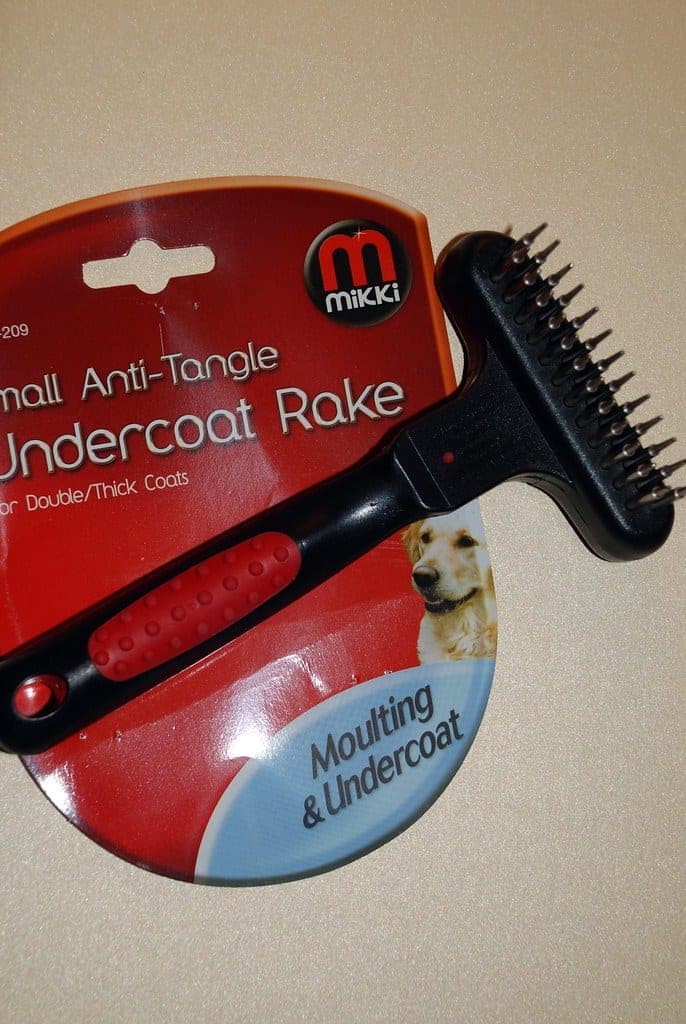
That fourth row is the one people get wrong most. A thick double coat is a shedding coat, but it sheds from underneath the guard layer, which a surface tool cannot reach and a slicker cannot pull. That is a job for a rake, compared against the FURminator here.

What a slicker is actually for

A slicker brush’s fine bent pins slide between hairs and lift a tangle apart rather than pulling it through. That is why it is the right tool for a growing coat and why technique matters: brushing only the top of a doodle’s coat leaves a solid felt layer at the skin while the surface looks perfectly groomed. The method is line brushing — part the coat in a line, brush from the skin outwards, move the line along — and it is covered on line brushing.

Pin quality is worth paying for here in a way it is not on most tools. Sharp, unfinished pin ends scratch, and a dog that has been scratched by a brush remembers the brush. A steel comb as a companion is non-negotiable: the comb is how you find out whether the slicker actually reached the skin.

Once a mat is solid enough that a comb will not pass between it and the skin, brushing it is painful and largely futile. That is a dematting job, or a clip-out underneath — and if you cannot see the skin, it is a professional’s job rather than a first-timer’s.

The decision

Pick a slicker brush if

  • Your dog's coat keeps growing and needs cutting periodically
  • You find tangles rather than loose hair on your hands
  • You own a doodle, poodle, Bichon, Yorkie, Maltese or Shih Tzu
  • You need something you can use every day without damaging the coat

Pick a deshedding blade if

  • Your dog's coat stops at a natural length and drops hair everywhere
  • The coat is short or medium and single-layered
  • You want maximum loose hair removed per pass, used occasionally
  • You have already read the warning about the cutting edge

The picks in full

Every pick, in order

01

Coats that grow and mat - doodles, poodles, silky coats

Chris Christensen Big G slicker brush

Fine flexible pins that lift tangles out of a growing coat without cutting any of it off.

A slicker brush with fine bent pins

Professional slicker brush

Pin density
About 30% more pins than a typical slicker
Sizes
Three
Best for
Doodles, poodles and long-coated breeds

Specs: Chris Christensen — Big G vs Big K slicker brushes

A slicker is the everyday tool for any coat that keeps growing, because the problem there is not loose hair but hair that has tangled and started to felt. Pin flexibility and finish are what separate a good slicker from a bad one: cheap pins have sharp ends that make dogs flinch and teach them to dislike brushing. Used with a steel comb to check the work, this is a doodle owner's most-used tool by a wide margin.

Tangle removal9.0
Comfort for the dog9.0
Coat safety9.5
Shedding coats6.0
Value7.0
Overall8.4 / 10

What it gets right

  • Pin density is the whole product: more pins means fewer passes through a curly coat
  • The pins are long enough to reach skin on a doodle, which is where matting starts
  • This is the brush that makes line brushing a doodle actually feasible

What it gets wrong

  • Expensive for a brush, by a wide margin
  • Dense pin bed is harder to clean out than a self-cleaning slicker
  • Overkill on a short coat

Who should skip itSkip it if your dog has a short or smooth coat — you will never use the pin density you paid for.

Check price on Amazon

#ad How we earn · We never print a price we cannot verify

02

Coats that shed - short and medium single layers

FURminator deShedding tool

A cutting edge that lifts a lot of loose hair fast from a shedding coat, used lightly.

An undercoat rake pulling loose undercoat from a dense coat

Bladed deshedding tool

Edge
Fine, close-set stainless edge
Works on
Short-to-medium coats, close to the skin
Sizes
Short-hair and long-hair variants per dog size
Feature
FURejector release button

Specs: Furric — Best Deshedding Tool

Against a slicker on a shedding coat, the deshedding blade removes more loose hair per pass and does it faster. That is a real advantage on a Labrador in May. The constraint is the same as always: it cuts, so light occasional passes rather than a daily brush, and a rake instead of it on a genuinely thick double coat.

Tangle removal4.5
Comfort for the dog7.0
Coat safety5.0
Shedding coats8.5
Value7.5
Overall6.9 / 10

What it gets right

  • On a short or medium coat it removes more loose undercoat per minute than anything else
  • The release button genuinely speeds up a big shed-out
  • Buying the right size-and-length variant makes a bigger difference than people expect

What it gets wrong

  • It is a blade. Over-used or used with pressure it thins and cuts the guard coat
  • The wrong variant for your coat length does nothing or does damage
  • Useless on a curly or felted coat

Who should skip itSkip it on a doodle, poodle or any coat that mats rather than sheds — it is the wrong category of tool.

Check price on Amazon

#ad How we earn · We never print a price we cannot verify

Read the full FURminator deShedding tool review

FAQ

Questions people actually ask

Can I use a slicker brush on a shedding dog?

Yes, and it is perfectly safe — just slower at removing loose hair than a purpose-built tool. Many owners keep a slicker for general tidying and a rake or deshedding blade for the volume work.

Do I need a comb as well as a slicker?

For any growing coat, yes. The slicker does the work and the steel comb checks it: if the comb passes cleanly from skin to tip, that section is done. Without a comb you are guessing, and the guess is usually wrong near the skin.

How do I stop the slicker scratching my dog?

Buy one with properly finished pin ends, hold it loosely rather than pressing, and brush in the direction the coat grows rather than scrubbing. If you can see pink skin after brushing, you are pressing too hard.

How this page was put together

We define the coat problem the tool has to solve, shortlist products currently sold, compare the manufacturers’ documented specifications against what that coat actually needs, and cross-check against published findings from named sources. We do not test these tools on our own dogs under controlled conditions, and we will not say we do. Where a figure comes from a manufacturer, we name them; where it comes from someone else’s testing, we cite them. We print no prices — a stale number is worse than none. Read the full method.
Sources

  1. 01Chris Christensen — slicker brush guide
  2. 02Dog Notebook — best slicker brushes for dogs