Scores are our own editorial assessment, not a product rating from reviews or testing. We do not print prices — every button goes to the current one on Amazon. #ad
Almost every “best dog clippers” list is organized by price tier, which is useless, because price does not tell you whether a clipper will stall on your dog. Coat does. A clipper that glides through a Labrador will bog down and heat up in a Goldendoodle’s armpit, and the same clipper is overkill for a Yorkie’s sanitary trim. So this page is organized by what the coat demands of the motor.
This page is for you if
You are clipping your own dog at home and want one clipper that suits its specific coat. If you already know the coat type, go straight to grooming by coat type and take the dedicated roundup.
You are on the wrong page if
Your dog has a double coat and you were planning to shave it. Read that page first — in most cases the correct answer is not to buy a clipper at all.
The one thing that decides this purchase
The short answer
Match the motor to the coat. Dense, curly or matted coat needs a corded two-speed or brushless clipper with detachable A5 blades. A short or already-maintained coat is fine on a cordless 5-in-1. Buying more clipper than the coat needs wastes money; buying less means it stalls and overheats.
Everything else — cordless versus corded, kit contents, color — is secondary to that. A stalling clipper is not just slow: it pulls hair instead of cutting it, which hurts, and it runs hot, which is how you get clipper burn.
How to read the specs that matter
Three numbers are worth your attention and the rest are marketing.
Spec
What it actually tells you
What to look for
Strokes per minute (SPM)
How fast the blade reciprocates. Higher cuts faster but heats faster.
3,000+ for body work. Two speeds beats one fixed speed.
Motor type
Rotary and brushless hold speed under load; magnetic and pivot motors do not.
Rotary or brushless for dense coat.
Blade system
Detachable A5 means any length, bought one blade at a time. 5-in-1 means five fixed lengths, forever.
A5 if the coat varies; 5-in-1 if it does not.
Cooling design
A vented, fanned housing pulls fine undercoat into the motor.
Vent-free housings last longer on doodles.
SPM figures for the Andis AGC Super 2-Speed are the manufacturer's published 3,400 / 4,400; see the source list below.
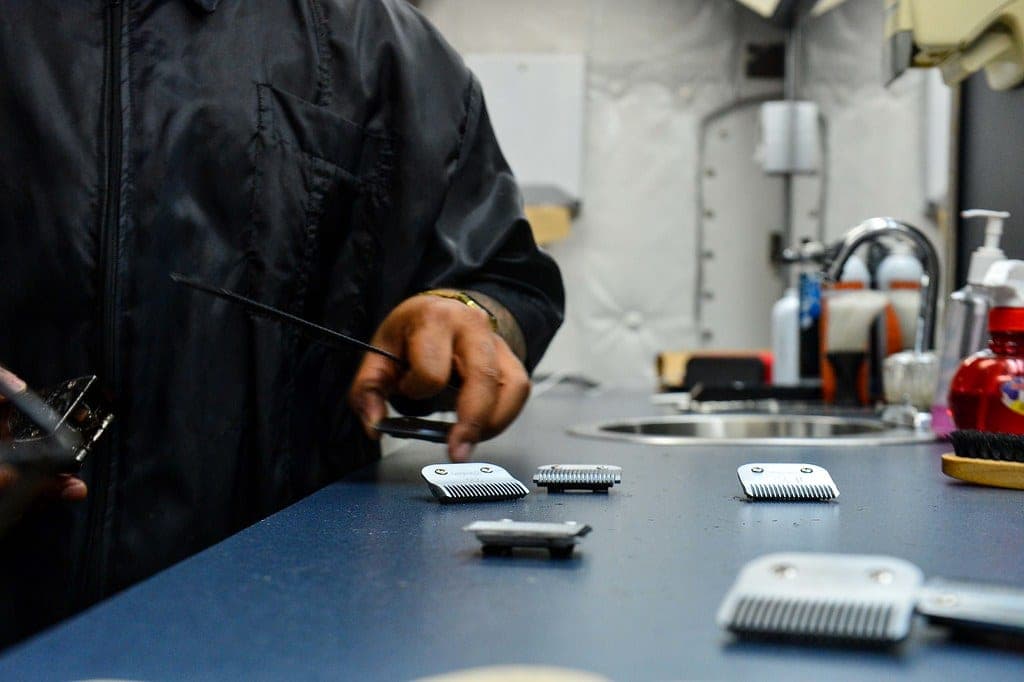
The blade, not the clipper, sets the cut length. One clipper plus three blades covers more coats than three clippers plus one blade.
Corded or cordless: pick by dog, not by preference
Cordless is more pleasant for you. Corded is better for the dog on any long job, because there is no point at which the tool slows down as the battery sags, and no mid-groom pause while you charge it. The practical rule: if a full groom takes you under 40 minutes, cordless is fine. If it takes longer — and a first attempt on a standard poodle always takes longer — buy corded, or buy a cordless unit that runs while plugged in.
Do not buy human clippers for this
Human hair clippers are built for 50–150 micron hair in one layer. Dog coat is coarser, denser, and often two layers. A human clipper will stall, pull and overheat, and the blade geometry is wrong for the job. The full comparison is on dog clippers vs human clippers.
What the picks above cost you in blades
A detachable-blade clipper ships with one blade, usually a #10. That is a 1/16 inch cut — far shorter than most owners want on the body. Budget for two more blades from the start: a #7F or #5F for the body and a #10 for sanitary areas. The blade size chart gives the exact cut length for every number, and the blade roundup covers which to buy first.
Owning the clipper is half of it
The most common complaint after a first home clip is not that the clipper was wrong — it is tram lines down the dog’s back. That is technique, not equipment: how to use dog clippers covers the first session end to end, and why clippers leave lines fixes the specific problem. If the blade is getting hot in your hand, read clippers overheating before you keep going.
The picks in full
Every pick, in order
01
Best for dense and curly coats
Andis UltraEdge AGC Super 2-Speed
The default right answer for a doodle, a poodle or any coat that stalls a cheaper motor.
Two things decide whether a clipper survives a dense coat: torque and heat. The AGC Super 2-Speed has a rotary motor running 3,400 or 4,400 SPM, and a housing with no vents or fan — which matters more than it sounds, because a fan intake on a doodle is a hair magnet, and a clogged fan is why cheap clippers die. It takes the whole A5 detachable blade range, so the clipper is a one-time purchase and the blades are how you adapt it to the coat in front of you.
Motor under load9.5
Heat management9.0
Blade options10.0
Handling7.5
Value8.5
Overall9.1 / 10
What it gets right
+Two usable speeds rather than one compromise speed — 3,400 SPM for bulk removal, 4,400 for finish work
+Takes the whole A5 detachable blade range, so one clipper covers every coat length you will ever need
+The vent-free housing is the reason it survives doodle coats: there is no fan intake for undercoat to pack into
+14 ft cord means you are not fighting an extension lead around a grooming table
What it gets wrong
−Corded, so you work around a cable with a dog that may not stand still
−Ships with one blade; a doodle or double coat needs at least two more, which is a real added cost
−Heavier in the hand than a cordless unit over a long session
Who should skip itSkip it if you own one short-coated small dog — this is more clipper than that coat will ever need.
A brushless motor that does not slow down when the blade hits a mat.
Corded brushless detachable-blade clipper
Speeds
Two-speed
Motor
Brushless, corded
Blade system
Detachable A5
Running temperature
Stays cool through dense coat work
Where the AGC is the sensible default, the KM Inspire is what you buy when the job is specifically hard: dense undercoat, felted patches, a Newfoundland in August. Brushless motors hold their speed under load rather than bogging, and they run cooler for longer, which is the actual mechanism behind clipper burn on a big dog. It is priced as a professional tool because it is one.
Motor under load10.0
Heat management9.5
Blade options10.0
Handling7.0
Value7.0
Overall8.9 / 10
What it gets right
+The brushless motor is the point: it pushes through matted coat and dense undercoat without bogging down
+Runs cool on long sessions, which is what actually causes clipper burn on a big dog
+Detachable A5 blades, so it shares the blade set with Andis and Oster clippers
What it gets wrong
−Priced like a professional tool because it is one
−Corded only
−Overkill for a single small dog on a monthly tidy-up
Who should skip itSkip it unless you are regularly working through dense or matted coat — a lighter clipper is easier to handle for everything else.
#adHow we earn · We never print a price we cannot verify
03
Best cordless for a maintained coat
Wahl Bravura Lithium
Five cut lengths from one blade, no cable, quiet enough that most dogs tolerate it.
Cordless adjustable-blade clipper
Power
Lithium-ion, cordless (corded operation while charging)
Blade
Adjustable 5-in-1 blade
Cut lengths
Five settings from one blade, no blade swaps
Noise
Quieter than a rotary corded clipper
The Bravura's 5-in-1 adjustable blade is the honest reason to buy cordless: you change length with a lever instead of buying and swapping blades. That is a genuine win on a dog you groom every four weeks and a genuine loss on a dog that arrives matted, because an adjustable blade has less bite than a dedicated skip-tooth. Buy it for maintenance, not for rescue work.
Motor under load7.0
Heat management8.5
Blade options6.0
Handling9.5
Value8.5
Overall7.9 / 10
What it gets right
+The 5-in-1 blade is the honest advantage: five cut lengths without buying or changing a blade
+Cordless, so you can turn the dog instead of walking the cable around it
+Quiet enough that a sound-sensitive dog will usually tolerate it
+Runs plugged in when the battery dies mid-groom
What it gets wrong
−The 5-in-1 blade does not have the bite of a dedicated skip-tooth blade on a matted coat
−Battery runtime is finite — a full standard poodle is more than one charge of careful work
−You cannot fit the wider A5 blade range to it
Who should skip itSkip it if your dog is matted — a 5-in-1 blade will drag through felted coat rather than cut it.
The original A5 clipper, still the torque benchmark for long knot-prone coat.
Corded detachable-blade clipper
Speeds
Two-speed
Motor
Universal rotary, corded
Blade system
Detachable A5 (the system is named after it)
Reputation
Heavy-duty clipping of long, knot-prone coats
The A5 blade system is named after this clipper, which tells you how long it has been the reference. What you get is torque and serviceability: parts exist, worn units get repaired rather than replaced, and used blades are everywhere and cheap. What you give up is noise and vibration — it is the loudest clipper here by a clear margin, and on a noise-reactive dog that single fact outweighs everything else.
Motor under load9.0
Heat management7.0
Blade options10.0
Handling6.5
Value9.0
Overall8.3 / 10
What it gets right
+The original A5 clipper — blade availability is effectively unlimited and cheap second-hand
+Torque where it matters: long coats prone to matted knots are what it was built for
+Serviceable. Parts exist, and a worn unit can be repaired rather than binned
What it gets wrong
−Loud and it vibrates more than a modern brushless clipper
−Runs warmer than the newer vent-free housings, so blade temperature needs watching
−Heavier than anything cordless
Who should skip itSkip it if your dog is noise-reactive — this is the loudest clipper in this set.
The rare cordless clipper you can put a real detachable blade on.
Cordless detachable-blade clipper
Speed
3,000 SPM
Power
Cordless, lithium-ion
Blade system
Detachable A5
Positioning
Professional-grade cordless for extended runtime
Almost every cordless clipper locks you into a 5-in-1 adjustable blade. The Pro 3000i does not: it runs at 3,000 SPM off a lithium battery and accepts detachable A5 blades, so you keep the blade library and lose the cable. It is slower than a corded two-speed at full tilt, so bulk removal takes longer, and the battery is a consumable with a finite life. For a dog that will not stand near a cord, that trade is worth making.
Motor under load8.0
Heat management8.5
Blade options10.0
Handling9.0
Value7.0
Overall8.5 / 10
What it gets right
+Cordless but still takes detachable A5 blades — a genuinely unusual combination
+Runtime is built for a full groom rather than a tidy-up
+3,000 SPM is enough for body work on most coats
What it gets wrong
−Slower than a corded two-speed at its top setting, so bulk removal takes longer
−Battery is a consumable; eventually it is a cost
−Premium price for the cordless convenience
Who should skip itSkip it if a cable genuinely does not bother you — a corded two-speed gives more motor for the money.
#adHow we earn · We never print a price we cannot verify
06
Best first clipper under budget
oneisall Dog Clippers for Thick Heavy Coats
The cheapest honest entry point, as long as you accept working in passes.
Cordless clipper with guide combs
Power
Cordless, rechargeable (usable while charging)
Blade
Ceramic-and-steel detachable cutting head
Included
Guide combs for stepped cut lengths
Positioning
Marketed for thick and heavy coats
This is the clipper to buy when you do not yet know whether you will keep doing this. It is cordless, quiet, light, and comes with guide combs so you can get an even length without knowing a blade number. It is not a professional motor: on a felted coat it will slow, and you have to brush the coat out properly first or the combs snag. For a monthly tidy on a maintained medium coat it does the job for a fraction of the price.
Motor under load5.5
Heat management6.5
Blade options5.0
Handling9.0
Value9.5
Overall7.1 / 10
What it gets right
+Far and away the cheapest entry point into clipping a thick coat yourself
+Guide combs mean you can get a usable, even length without blade knowledge
+Quiet and light, which is half the battle with a first-time dog
What it gets wrong
−It is not a professional motor — it will slow in felted coat and you must work in passes
−Guide combs snag if the coat is not brushed out first
−Long-term durability is not in the same class as an Andis or Wahl KM
Who should skip itSkip it if you are grooming weekly or working on a badly matted coat — it will not keep up.
#adHow we earn · We never print a price we cannot verify
FAQ
Questions people actually ask
+−What clippers do professional dog groomers use?
Overwhelmingly corded detachable-blade clippers in the A5 family — Andis AGC, Wahl KM and Oster A5 bodies — because they take the whole blade range and survive a full working day. Cordless units appear for faces, feet and sanitary work rather than for body clipping. Our groomer tool list goes through the whole kit.
+−Why are dog clippers so expensive?
You are paying for a motor that holds its speed against coat resistance and a housing that survives the hair. A $40 clipper and a $200 clipper both cut a clean coat; only one of them is still cutting after an hour in a dense one. The detachable blade system also means the body is a long-term purchase — most of the ongoing cost is blades.
+−Why are my dog clippers so loud?
Rotary and universal motors make more noise than the lithium cordless units, and a dry blade adds a lot of it. Oil the blade, then if the dog is genuinely reactive switch to a cordless clipper — the noise difference between an Oster A5 and a Wahl Arco SE is the single biggest factor in whether a sound-sensitive dog will stand still.
+−Can I use a regular shaver on my dog?
No. A foil or rotary shaver has no clearance for coat and will catch skin. Even a beard trimmer is the wrong tool — see dog clippers vs trimmers for where a trimmer does and does not belong.
+−How many clippers do I actually need?
One, plus blades, for most dogs. Two is worth it only if you own a large dense-coated dog and a small one: a corded body clipper plus a small cordless for faces and feet. Owners regularly buy a second clipper when what they needed was a different blade.
How this page was put together
We define the coat problem the tool has to solve, shortlist products currently sold, compare the manufacturers’ documented specifications against what that coat actually needs, and cross-check against published findings from named sources. We do not test these tools on our own dogs under controlled conditions, and we will not say we do. Where a figure comes from a manufacturer, we name them; where it comes from someone else’s testing, we cite them. We print no prices — a stale number is worse than none. Read the full method.