The five-speed version of the clipper most groomers already own. The speed dial is real and useful — but only two of the five settings will earn their keep on most dogs.
The Andis Excel 5-Speed+ is a corded A5 clipper with a 2,500-4,500 SPM speed dial instead of a two-position switch. The slow end is the reason to buy it — nervous dogs, sanitary work, anywhere heat matters. If you will only ever use low and high, the two-speed AGC does the same job for less.
Buy it if
You clip more than one kind of coat, or one dog that will not tolerate a loud fast clipper, and you want to set the speed to the job rather than pick from two.
Skip it if
You groom one dog with one blade on a six-week cycle. You will use two settings, the AGC Super 2-Speed gives you two settings and essentially the same top end, and the difference is real money.
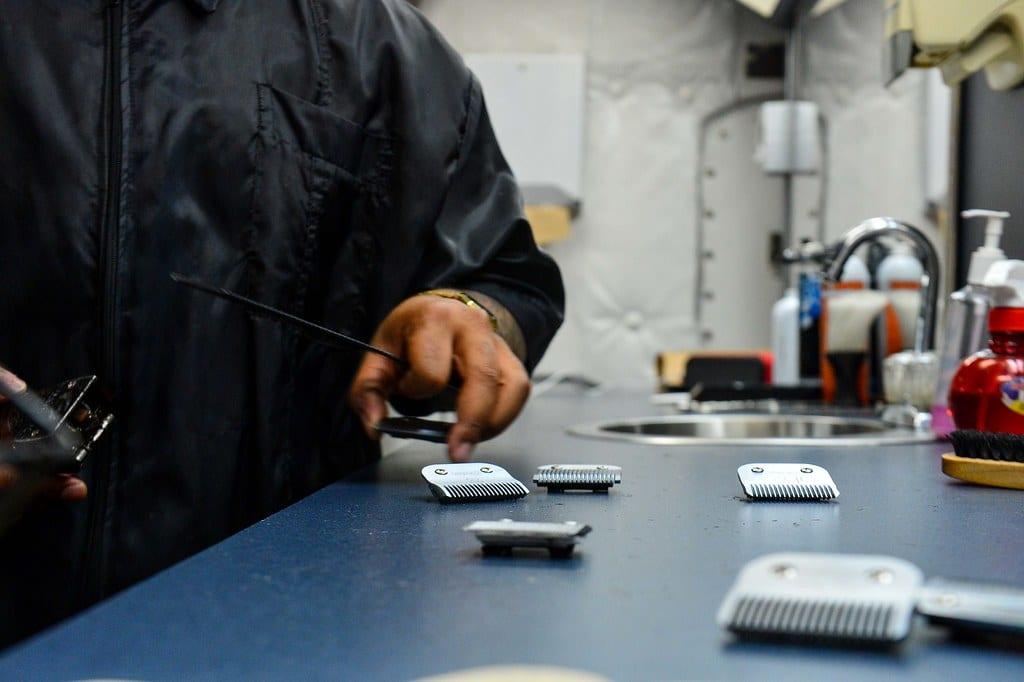
Detachable A5 blades on a grooming-room bench — the system this clipper buys into, and where the real long-term cost of owning one sits
What it gets right
The bottom of the speed range is the actual feature
Andis publishes the Excel 5-Speed+ at 2,500 to 4,500 strokes per minute across five settings. The number people look at is the 4,500 top end, and it is not the interesting one — the AGC Super 2-Speed already reaches 4,400. What this clipper gives you that a two-speed does not is 2,500 SPM, slower than anything on the AGC. Slow matters in three specific places: around a sanitary area, where a fast blade on thin skin is a burn waiting to happen; on a dog that flinches at motor pitch; and on a first pass through coat you have not assessed yet. Creeping a blade through an unknown area and then dialing up for the body is a genuinely different way of working, and it is the whole argument for this clipper.
Nothing about the blade system is proprietary
It takes the detachable A5 mount, and Andis lists M Force, UltraEdge and CeramicEdge blades as compatible. That is the same mount as the Andis AGC, the Oster A5 and the Wahl KM bodies, so every blade you buy outlives this clipper body. Blades, not bodies, are where the money goes over five years of home grooming — a working set is several blades plus guide combs — so a clipper that locks you into a proprietary adjustable blade is quietly the more expensive option even when it costs less on the day.
A CeramicEdge blade and a spare blade drive in the box
The standard US kit ships with a CeramicEdge blade, blade oil and an additional blade drive. The blade drive is the small part that converts the motor's rotation into the blade's side-to-side movement; it is the component that wears out and snaps first on any A5 clipper, and most clippers do not include a spare. Finding you already have one eighteen months in, rather than losing a week to ordering a part, is worth more than the part costs. The CeramicEdge blade also runs cooler than a steel equivalent at the same speed, which matters more on a clipper you will sometimes run flat out.
Light for a corded professional body, with a long cord
Andis publishes 12.8 oz and a 14 ft cord. The AGC Super 2-Speed, for comparison, is a little over 17 oz. Four ounces sounds like nothing written down and is very noticeable ninety minutes into a standard poodle, because that weight sits at the end of your arm in a pinch grip the entire time. The 14 ft cord is the other practical number: long enough to walk a full circle around a grooming table without an extension lead, which is the difference between managing a cable and fighting one.
It is the right clipper for a household with different coats in it
The case for a speed dial gets stronger the less alike the coats in the house are. A wire-coated terrier, a doodle and a short-coated senior do not want the same blade speed, and matching speed to coat is a real variable rather than a marketing one: faster strokes cut dense coat more cleanly and generate more heat doing it. If you groom two or three very different dogs, or you are the person in the family who ends up doing the neighbors' as well, the dial stops being a luxury and starts being the reason the session goes quickly.
What it gets wrong
You are paying for settings you will not use
This is the honest core of it. Five settings across 2,500 to 4,500 SPM puts roughly 500 SPM between adjacent positions, which is below the point at which most people can tell the difference on a dog. In practice almost everyone settles into two: a slow one for faces, feet and sanitary work, and a fast one for the body. If that is you, the AGC Super 2-Speed gives you exactly those two at 3,400 and 4,400, usually for meaningfully less. Clipper pricing at this level moves a lot with promotions, so check both before you decide rather than assuming a fixed gap.
The top speed is not higher than the two-speed clipper's
At 4,500 SPM the Excel's ceiling is essentially the AGC's 4,400. Nobody buying a five-speed should expect more cutting power than the two-speed: the dial spreads the range downward, not upward. If what is actually stopping you is a clipper bogging down in dense coat, more speed settings will not fix it. A brushless motor that holds its speed under load will, and that is a different clipper and a different budget.
Corded, with everything that implies
There is no cordless version of this clipper in the line. You are walking a 14 ft cable around an animal that may decide to move, which on a large dog is a nuisance and occasionally a hazard — a cord wrapped round a leg while you are holding a running blade is a genuinely bad moment. If the cable is the reason home grooming has not stuck for you, a speed dial will not change that, and a cordless A5 body is the thing to look at instead.
Andis does not publish a noise figure, and rotary motors are not quiet
The product listing says nothing about decibels, so we will not invent a number. What the design tells you is that this is a rotary motor, rotary motors make more noise than a lithium cordless unit, and running at 4,500 SPM is louder than running at 2,500. For a noise-reactive dog the dial helps, because you can work at the quiet end — but it does not make this a quiet clipper. If sound is the whole problem, a cordless unit is a better starting point than a quieter setting on a loud one.
The two-year warranty is standard, not generous
Andis lists two years. That is normal for the category, shorter than the five-year cover some dryer manufacturers put on a motor, and it does not reach blades, blade drives or anything caused by running a dry blade. Clipper warranties almost never fail owners on the motor; they fail them on the parts that wear, and those are excluded here as they are everywhere. Budget oil and a replacement blade drive as running costs, not as faults.
A slow setting is not permission to push
The low end of this dial makes it tempting to drive a blade into a mat slowly rather than not at all. Slow does not make it safe. A mat sits tight against the skin and lifts it, the blade reaches skin before you feel any resistance, and the cut is the same cut at 2,500 SPM as it is at 4,500.
Work a #10 flat underneath the mat, between the felt and the dog, and take the mat off whole. If the blade will not go under it, the dog needs a groomer or a vet rather than a different speed setting.
One maintained coat, and you would rather have five lengths from one adjustable blade and no cable.
How we assessed it
This assessment rests on the manufacturer’s documented specifications and on published findings from the named sources at the foot of the page, compared against what the coat types in question actually require. We did not test this unit on our own dogs under controlled conditions, and we will not claim to have done. Where a figure comes from a manufacturer we say so; where it comes from someone else’s testing we cite them. The score is our editorial assessment, not a product rating derived from reviews or measurements. Full method on how we review.
The product
Reviewed in full on this page
01
Reviewed in full on this page
Andis Excel 5-Speed (SMC)
The Andis Excel 5-Speed+ is a corded A5 clipper with a 2,500-4,500 SPM speed dial instead of a two-position switch. The slow end is the reason to buy it — nervous dogs, sanitary work, anywhere heat matters. If you will only ever use low and high, the two-speed AGC does the same job for less.
You clip more than one kind of coat, or one dog that will not tolerate a loud fast clipper, and you want to set the speed to the job rather than pick from two.
Speed control9.5
Motor under load8.0
Blade options10.0
Handling8.5
Value for one dog6.5
Overall8.3 / 10
What it gets right
+The slowest setting is genuinely slow, which matters on a nervous dog and around sanitary areas
+Same detachable A5 blade ecosystem as the AGC, so blades carry over
+Steps up to full speed for bulk removal on a dense coat
What it gets wrong
−You pay for speed settings most home groomers use two of
−Corded, with the same cable-management problem as the AGC
−More motor noise at the top settings than a cordless lithium unit
Who should skip itSkip it if you already own a two-speed clipper that handles your dog — the extra settings will not change your result.
Andis publishes 2,500 to 4,500 strokes per minute across five settings, driven by a corded rotary motor on 120 V / 60 Hz.
+−Is the Excel 5-Speed+ better than the Andis AGC Super 2-Speed?
Only if you will use the slow end. The AGC runs 3,400 and 4,400 SPM, so the Excel's advantage is the 2,500 SPM setting below anything the AGC offers, not a higher ceiling. For one dog and one blade, the AGC is the better value.
+−What blades fit the Excel 5-Speed+?
Andis lists M Force, UltraEdge and CeramicEdge detachable blades. It is the standard A5 mount, so Oster A5 and Wahl Competition blades fit as well. It does not take a proprietary adjustable 5-in-1 blade.
+−What comes in the box?
The standard US kit lists a CeramicEdge blade, blade oil and an additional blade drive. Contents vary between the blue, indigo and international versions — one US variant ships a Super Blocking Blade instead — so check the listing you are buying from.
+−How heavy is it, and how long is the cord?
Andis publishes 12.8 oz and a 14 ft cord. That is several ounces lighter than the AGC Super 2-Speed, which you notice over a long groom on a large dog.
+−How often does it need oiling?
Three drops across the blade teeth before you start and every ten minutes of running. No speed setting compensates for a dry blade, and a dry blade is what burns a dog.
How this page was put together
We define the coat problem the tool has to solve, shortlist products currently sold, compare the manufacturers’ documented specifications against what that coat actually needs, and cross-check against published findings from named sources. We do not test these tools on our own dogs under controlled conditions, and we will not say we do. Where a figure comes from a manufacturer, we name them; where it comes from someone else’s testing, we cite them. We print no prices — a stale number is worse than none. Read the full method.