Scores are our own editorial assessment, not a product rating from reviews or testing. We do not print prices — every button goes to the current one on Amazon. #ad
“Thick” covers two different problems that need different answers. A thick double coat — husky, shepherd, retriever — is dense undercoat under harsh guard hair, and should usually be raked rather than clipped. A thick single coat — doodle, poodle, bichon — keeps growing and has to be cut. This page covers the clipper choice for both; which of them you should actually be doing is on the coat pages.
This page is for you if
Your clipper is bogging down, pulling, or getting hot, and you want to know what to buy instead.
You are on the wrong page if
Your clipper works but leaves tram lines — that is technique, and the fix is on clipper lines and tracking.
Why cheap clippers stall on thick coat
The short answer
A magnetic-motor clipper produces its rated speed with no load and loses most of it against coat resistance. A rotary or brushless motor compensates and holds speed. That is why a $40 clipper buzzes loudly and cuts nothing in dense hair while a $180 one keeps going at the same rate.
You can hear it happen. A clipper that drops in pitch as it enters the coat is losing speed, and a clipper losing speed is pulling hair rather than cutting it. That is what the dog objects to, and it is also what makes the blade hot.
Blade choice halves the work
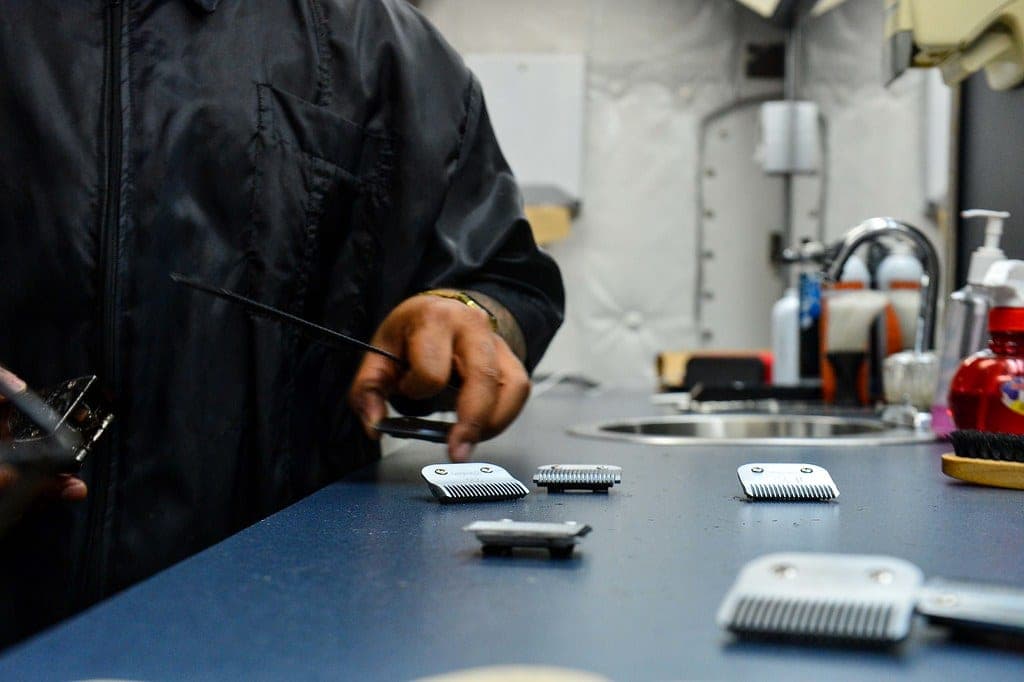
On thick coat, a skip-tooth blade — wider-spaced teeth, designated without the F or FC suffix — takes bulk far faster than a finish-cut blade of the same number, because it does not try to take every hair in one pass. The standard approach is: skip-tooth to remove bulk, then a finish-cut blade one length shorter for a smooth surface. Full comparison on blades vs guard combs.
Tooth spacing, not blade number, is what decides how much coat the blade can take per pass.
Never use a skip-tooth blade on feet, faces or sanitary areas
The wide tooth spacing that makes a skip-tooth good at bulk also lets skin into the gap. Keep skip-tooth blades on the body only, and use a finish-cut blade or a 5-in-1 anywhere near thin skin or a fold.
Keeping the blade cool is most of keeping the dog safe
A clipper working hard in thick coat will put a blade above skin-safe temperature in a few minutes. Oil it every ten minutes, keep a second blade in rotation so one cools while you use the other, and check the blade against the inside of your own wrist, not against the dog. The whole routine is on why clippers get hot and what to do, and the consequence of ignoring it is on clipper burn prevention.
The picks in full
Every pick, in order
01
Best for the thickest coat you will meet
Wahl KM Inspire
Brushless, cool-running, and it does not drop speed when the coat fights back.
Corded brushless detachable-blade clipper
Speeds
Two-speed
Motor
Brushless, corded
Blade system
Detachable A5
Running temperature
Stays cool through dense coat work
Thickness is resistance, and resistance is what separates clipper motors. A brushless motor compensates for load rather than slowing under it, which is why the KM Inspire keeps cutting through dense undercoat and felted patches that make a magnetic clipper buzz uselessly. The cool running matters as much: thick coat means long sessions, and a hot blade on skin you cannot see is the real risk.
Speed held under load10.0
Blade temperature9.5
Blade range10.0
Weight in the hand7.0
Value7.0
Overall8.9 / 10
What it gets right
+The brushless motor is the point: it pushes through matted coat and dense undercoat without bogging down
+Runs cool on long sessions, which is what actually causes clipper burn on a big dog
+Detachable A5 blades, so it shares the blade set with Andis and Oster clippers
What it gets wrong
−Priced like a professional tool because it is one
−Corded only
−Overkill for a single small dog on a monthly tidy-up
Who should skip itSkip it unless you are regularly working through dense or matted coat — a lighter clipper is easier to handle for everything else.
This is the clipper that makes most thick-coat buying decisions straightforward. At 3,400 SPM it clears bulk; at 4,400 it finishes. The housing has no vents or fan, so the fine hair that thick coats shed cannot pack into the motor — the usual failure mode for clippers used on this coat. Seventeen and a half ounces is noticeable over an hour but manageable.
Speed held under load9.5
Blade temperature9.0
Blade range10.0
Weight in the hand7.5
Value8.5
Overall9.0 / 10
What it gets right
+Two usable speeds rather than one compromise speed — 3,400 SPM for bulk removal, 4,400 for finish work
+Takes the whole A5 detachable blade range, so one clipper covers every coat length you will ever need
+The vent-free housing is the reason it survives doodle coats: there is no fan intake for undercoat to pack into
+14 ft cord means you are not fighting an extension lead around a grooming table
What it gets wrong
−Corded, so you work around a cable with a dog that may not stand still
−Ships with one blade; a doodle or double coat needs at least two more, which is a real added cost
−Heavier in the hand than a cordless unit over a long session
Who should skip itSkip it if you own one short-coated small dog — this is more clipper than that coat will ever need.
The torque benchmark for long coats prone to knots, at the cost of noise.
Corded detachable-blade clipper
Speeds
Two-speed
Motor
Universal rotary, corded
Blade system
Detachable A5 (the system is named after it)
Reputation
Heavy-duty clipping of long, knot-prone coats
Where the KM is refined and the AGC is balanced, the A5 is blunt: a universal motor that moves coat. For long thick coat that knots rather than felts — the Bernese, the rough collie, the long-coated shepherd — that bluntness is exactly right. Accept the noise and the vibration, or accept a slower groom with a quieter tool.
Speed held under load9.0
Blade temperature7.0
Blade range10.0
Weight in the hand6.5
Value9.5
Overall8.4 / 10
What it gets right
+The original A5 clipper — blade availability is effectively unlimited and cheap second-hand
+Torque where it matters: long coats prone to matted knots are what it was built for
+Serviceable. Parts exist, and a worn unit can be repaired rather than binned
What it gets wrong
−Loud and it vibrates more than a modern brushless clipper
−Runs warmer than the newer vent-free housings, so blade temperature needs watching
−Heavier than anything cordless
Who should skip itSkip it if your dog is noise-reactive — this is the loudest clipper in this set.
Full speed for the thick body, a genuinely slow setting for the parts near skin.
Corded detachable-blade clipper
Speeds
Five selectable speeds
Motor
Rotary, corded
Blade system
Detachable A5
Use case
Variable-speed work across coat types
Thick-coated dogs still have thin-coated areas: inner thighs, armpits, the belly. Dropping to a low speed for those is safer and calmer than running flat out everywhere, and five settings mean you are not choosing between two compromises. You pay for settings most owners use two or three of.
Speed held under load8.5
Blade temperature8.5
Blade range10.0
Weight in the hand7.0
Value7.0
Overall8.3 / 10
What it gets right
+The slowest setting is genuinely slow, which matters on a nervous dog and around sanitary areas
+Same detachable A5 blade ecosystem as the AGC, so blades carry over
+Steps up to full speed for bulk removal on a dense coat
What it gets wrong
−You pay for speed settings most home groomers use two of
−Corded, with the same cable-management problem as the AGC
−More motor noise at the top settings than a cordless lithium unit
Who should skip itSkip it if you already own a two-speed clipper that handles your dog — the extra settings will not change your result.
#adHow we earn · We never print a price we cannot verify
05
Best budget option, with eyes open
oneisall Dog Clippers for Thick Heavy Coats
Marketed for thick coats and workable on them, as long as you brush first and work in passes.
Cordless clipper with guide combs
Power
Cordless, rechargeable (usable while charging)
Blade
Ceramic-and-steel detachable cutting head
Included
Guide combs for stepped cut lengths
Positioning
Marketed for thick and heavy coats
It carries the thick-coat claim and it is not fraudulent: with the coat properly brushed out and a willingness to take two passes where a pro clipper takes one, it gets the job done on a medium-sized dog. The limits are real — felted coat will defeat it and the long-term durability is not in the same class — but it is a tenth of the price of the units above it.
Speed held under load5.5
Blade temperature6.0
Blade range5.0
Weight in the hand9.0
Value9.5
Overall7.0 / 10
What it gets right
+Far and away the cheapest entry point into clipping a thick coat yourself
+Guide combs mean you can get a usable, even length without blade knowledge
+Quiet and light, which is half the battle with a first-time dog
What it gets wrong
−It is not a professional motor — it will slow in felted coat and you must work in passes
−Guide combs snag if the coat is not brushed out first
−Long-term durability is not in the same class as an Andis or Wahl KM
Who should skip itSkip it if you are grooming weekly or working on a badly matted coat — it will not keep up.
#adHow we earn · We never print a price we cannot verify
FAQ
Questions people actually ask
+−Why do my dog clippers not cut through thick hair?
In order of likelihood: the coat is not brushed out, the blade is dull, the blade is dry, or the motor is too weak. The first three are free to fix. Only after ruling them out is the clipper itself the problem.
+−What is the difference between a skip-tooth and a finish-cut blade?
Tooth spacing. Skip-tooth blades have alternating long and short teeth and take bulk quickly but leave a coarser surface and are unsafe near skin. Finish-cut (F or FC) blades have evenly spaced teeth, cut smoother and are safe on faces and sanitary areas.
+−Should I bathe before or after clipping a thick coat?
Before, always, and dry thoroughly. Clipping a dirty coat dulls blades fast and gives a rough finish. Clipping a damp coat is worse — it drags. Brush out, bathe, dry completely with a force dryer, then clip.
+−How often should I oil the blade on thick coat?
Every ten minutes of running time, and always before you start. Three drops across the teeth, run the clipper for a few seconds, wipe the excess. This single habit does more for blade life and temperature than any other.
How this page was put together
We define the coat problem the tool has to solve, shortlist products currently sold, compare the manufacturers’ documented specifications against what that coat actually needs, and cross-check against published findings from named sources. We do not test these tools on our own dogs under controlled conditions, and we will not say we do. Where a figure comes from a manufacturer, we name them; where it comes from someone else’s testing, we cite them. We print no prices — a stale number is worse than none. Read the full method.