Scores are our own editorial assessment, not a product rating from reviews or testing. We do not print prices — every button goes to the current one on Amazon. #ad
Why a table changes the job
The short answer
A grooming table does three things: it puts the dog at your working height so you are not stooping, a non-slip top stops it sliding so it stands square, and the arm and loop remove its option to wander off. Together those are most of what makes a home groom possible, and they matter more than any tool upgrade.
Grooming on the floor means kneeling, chasing, and holding the dog with one hand while operating a tool with the other. That is how people nick ears and give up halfway through. A table also changes the dog’s understanding of the situation: being on the table becomes a defined activity with a beginning and an end, rather than an ambush in the living room.
Setting it up
Height. The dog’s back should sit around your waist to lower-rib height, which lets you work with a straight back and see what you are doing. Too low and you will stoop for two hours; too high and you lose fine control of the tools.
Position. Somewhere you can walk all the way round the dog, with light on both sides, and a floor you can sweep or hose. Grooming produces a remarkable amount of hair.
Tools laid out first. Everything within arm’s reach before the dog gets on, because of the rule below.
Never leave a looped dog unattended. No exceptions.
A grooming loop is a reminder, not a tether. A dog that jumps or falls off a table while looped can injure its neck badly, and it happens in seconds. Do not step away to answer the door, take a call, or fetch a tool from across the room.
If you need both hands free and the dog is unsettled, take the dog off the table. If you need something you forgot, take the dog off the table. That is the whole rule and it is why laying tools out in advance is a safety step rather than a convenience.
Fitting the loop correctly
The loop goes high on the neck, just behind the ears, not low on the throat. Low placement puts pressure on the trachea if the dog pulls; high placement sits against the solid part of the neck and simply stops forward movement. Two fingers should slide comfortably between the loop and the neck — tight enough that the dog cannot back out, loose enough that it is not holding the dog up.
For a dog that sits down repeatedly, a second loop under the belly (a haunch loop) attached to the same arm keeps it standing without any pressure on the neck. That is a better answer than tightening the neck loop, which is never the answer.
Introducing a dog to the table
01
Session one: on and off, nothing else
Lift the dog on, give something good, lift it off. Repeat a few times. The whole session is thirty seconds and the dog learns the table is boring.
02
Session two: add standing still
On the table, stand for ten seconds, reward, off. Build up to a minute over a few sessions.
03
Session three: add the loop
Fit it, reward, remove it, and off. Do not combine the loop's first appearance with any actual grooming.
04
Session four: add one tool, switched off
Let the dog see and sniff the brush or clipper on the table, then put it down and end the session.
05
Session five: a real but short job
Brush one side, or do two nails. Then off, with a reward on the floor.
06
From then on: normal sessions, always ended early
Take the dog off before it asks. A dog that has never been on a table until it was fed up will keep standing for you.
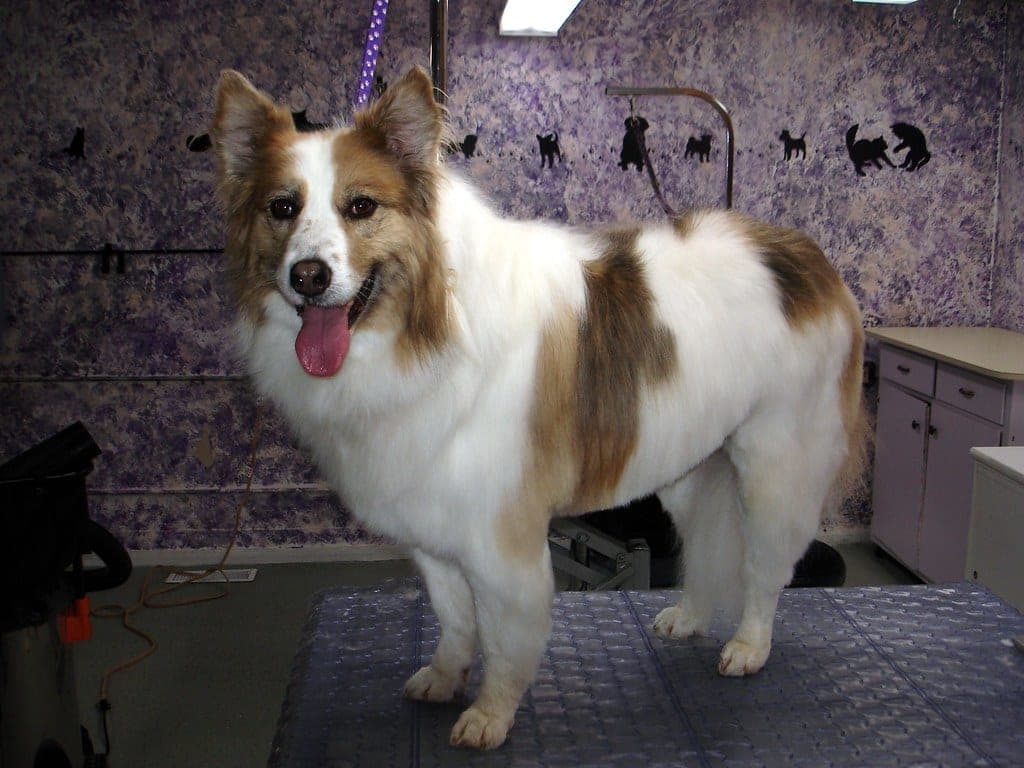
A ribbed non-slip top is most of what you are paying for: it is why the dog stands square instead of bracing.
Choosing the table itself
Three specifications, in order. Weight rating — and note that it has to cover the dog leaning, shifting and being leaned on by you, so a comfortable margin matters. Top size, which should let the dog stand square with all four feet on the surface; measure your dog nose to tail base and buy longer than that figure. And the height mechanism: fixed is cheapest and perfectly fine for one person and one dog, while hydraulic or electric lets the dog step on rather than being lifted, which matters a great deal for big or elderly dogs.
What you are paying for in a table is the frame bracing and the top. A table that rocks when the dog shifts weight teaches the dog that the table is unsafe, which undoes the whole benefit. A proper ribbed rubber top is the rest of it: the non-slip surface is why the dog stands square instead of bracing.
Stability9.0
Top size and grip9.0
Weight rating9.0
Storage6.5
Value8.0
Overall8.5 / 10
What it gets right
+Arm included, which is the part people forget to budget for and then need immediately
+Folds, so it does not permanently occupy a room in a house
+Multiple sizes means you can match the table to the dog rather than the other way round
What it gets wrong
−Folding legs are the weak point on any folding table over years of use
−You still have to lift the dog onto it
−Rubber top holds hair and needs real cleaning
Who should skip itSkip it if your dog is over about 70 lb and you cannot lift — you want a low-entry or electric table.
#adHow we earn · We never print a price we cannot verify
02
The arm, which is half the point
Master Equipment grooming arm with loop
A rigid arm with a clamp that does not flex - the part budget tables get wrong.
Grooming arm and restraint
Fitting
Clamps to a table edge
Adjustment
Height-adjustable post
Included
Grooming loop
The stock arm on a cheap table is usually the component that flexes, and a flexing arm lets the dog lean and win. A rigid arm with a solid clamp is a worthwhile standalone purchase even if your table came with one, and it is inexpensive relative to the table. It is also the piece that makes a double loop possible for a dog that sits down.
Rigidity9.0
Clamp security9.0
Adjustability8.5
Build quality8.5
Value8.5
Overall8.7 / 10
What it gets right
+An arm turns two hands of dog-holding into two hands of grooming — it is the highest-value accessory here
+Height-adjustable, so the loop sits where it should on any size dog
+Clamps to most table edges rather than needing a matching table
What it gets wrong
−A loop is a positioning aid, not a restraint, and a dog must never be left in one
−Clamp can mark a table edge
−Cheap arms wobble; this is why you buy a branded one
Who should skip itSkip it only if your dog already stands still unaided — almost nobody's does.
Lifting a 90 lb dog onto a table repeatedly is the thing that stops people grooming large breeds at home, and it is harder on an arthritic dog than on the owner. An electric table removes the lift entirely. For a small dog it is an indulgence; for a big or old one it is often what makes home grooming possible at all.
Height mechanism9.5
Weight rating9.0
Stability8.5
Storage4.5
Value6.0
Overall8.0 / 10
What it gets right
+The low entry height is the real feature: a senior or arthritic dog walks on instead of being lifted
+Removes the single biggest injury risk in home grooming, which is you lifting the dog
+Height adjustment mid-groom saves your back on a long session
What it gets wrong
−The most expensive item in this whole category by a wide margin
−Needs a power outlet and a permanent floor footprint
−A motor is one more thing that can fail
Who should skip itSkip it if you own a 15 lb dog you can lift one-handed — you are buying a solution to a problem you do not have.
#adHow we earn · We never print a price we cannot verify
FAQ
Questions people actually ask
+−Is a grooming loop safe?
Used correctly and never unattended, yes — fitted high on the neck with two fingers of slack, it simply prevents the dog walking away. The hazard is entirely about leaving a looped dog alone, which is why that rule has no exceptions.
+−My dog keeps sitting down on the table. What do I do?
Add a belly or haunch loop under the abdomen attached to the same arm, which holds the dog standing with no pressure on the neck. Do not tighten the neck loop to achieve the same thing.
+−What size table do I need?
Long enough for the dog to stand square with all four feet on the top — measure nose to tail base and buy longer. For most large breeds that means 36 inches or more. A folding table answers the storage problem better than a small one does.
+−Can I use a regular table with a towel?
It is better than the floor, but the towel slides and the dog knows it, so it braces instead of standing. The non-slip ribbed top is most of what a grooming table is. A fixed-height one is inexpensive and a far better buy than improvising.
How this page was put together
We define the coat problem the tool has to solve, shortlist products currently sold, compare the manufacturers’ documented specifications against what that coat actually needs, and cross-check against published findings from named sources. We do not test these tools on our own dogs under controlled conditions, and we will not say we do. Where a figure comes from a manufacturer, we name them; where it comes from someone else’s testing, we cite them. We print no prices — a stale number is worse than none. Read the full method.