A mat is attached to living skin, which is why dematting goes wrong. The technique is always the same: support the base, work the loose edge, and never pull.
Scores are our own editorial assessment, not a product rating from reviews or testing. We do not print prices — every button goes to the current one on Amazon. #ad
The short answer
The short answer
Pinch the hair between the mat and the skin with your free hand, then draw the dematter through the mat’s outer edge in short strokes, away from the skin. Comb out what releases, then work a little deeper. Never start in the middle and never pull.
This page is for you if
You have found a mat — or several — and you want to get it out without hurting the dog or shaving the whole coat off.
You are on the wrong page if
The coat is felted into a solid sheet you cannot lift away from the skin. That is past dematting; read the matted-coat clipping guide instead.
Why dematting hurts when it goes wrong
A mat is not a lump sitting on the coat. It is a disc of felted hair whose individual hairs are still rooted in living skin, and it tightens from the outside in — which means the part closest to the skin is the tightest part. Pull on a mat and the force travels down every one of those hairs into the follicle, which is why a dog that has been dematted roughly once will not offer you that side of its body again.
A dematting tool does not remove a mat. It splits it: the blades cut through the felt so the mat becomes several smaller mats, each of which is loose enough to comb out. Understanding that changes how you use it. You are making cuts, repeatedly, from the outside in — not raking at a lump hoping it comes off.
Which tool, and what to look for
Tool
What it does to a mat
Use it when
Bladed dematter (7–12 blades)
Cuts through felt, splitting the mat into sections
The mat is set and a comb will not enter it
Dual-sided rake
Coarse side splits, fine side clears the surrounding coat
You found the mat mid-deshedding session
Metal comb
Tests progress and removes released hair
After every two or three tool strokes, always
Dense slicker brush
Works loosened coat to the skin and prevents the next mat
To finish the area, and weekly thereafter
Clippers with a #10 blade
Removes the mat and the coat under it entirely
The mat is flat to the skin and nothing else will pass under it
Tool characteristics follow the sources cited below; the decision rules are this site's own.
Blade count is the one specification worth thinking about. Fewer blades (around seven to nine) bite into a dense mat and are the right choice on a set one; more blades (fifteen and up) take less coat per stroke and suit a thinner or finer coat where you want to keep as much as possible. Curved blades draw through the mat with the stroke; straight ones are more likely to catch.
The hand position that matters: the free hand pinches between mat and skin so every stroke pulls against you, not the dog.
The procedure
01
Find the edge of the mat
Work your fingers around the lump until you can feel where felted hair becomes free coat. That boundary is where the tool goes. Never start in the middle.
02
Support the base with your free hand
Pinch the hair between the mat and the skin and hold it firmly, so every stroke pulls against your hand rather than the dog. This one habit prevents most dematting injuries.
03
Cut into the outer edge in short strokes
Draw the blades through the outer inch of the mat, away from the skin, in strokes of two or three inches. You are splitting the mat, not removing it in one pass.
04
Comb out what you have released
After every two or three strokes, comb the loosened hair away with a metal comb. If the comb passes through, that part is done; if it stops, go back to the tool.
05
Work inward, a layer at a time
Repeat the split-and-comb cycle, moving a little closer to the skin each round. A large mat takes many short cycles, and shortcutting it is what causes a tear.
06
Finish with a slicker brush to the skin
Once the comb passes cleanly, brush the area out properly with a dense slicker so no small tangles are left to seed the next mat.
07
Stop after fifteen minutes on one spot
Dematting is uncomfortable and dogs run out of patience before you run out of mat. Do one area, reward the dog, and come back tomorrow.
Know when to stop and clip instead
If you cannot lift the mat away from the skin, if the skin underneath is red, damp or smells, or if the matting covers a whole flank rather than a patch, stop. Dematting that coat will take hours and hurt the whole time, and the kind thing is to clip it off and start the coat again. The clipping procedure explains how to get a blade under felt safely. A coat grows back; a dog’s trust in being handled takes much longer.
Where mats form, so you can find them early
Mats appear where friction and moisture meet, which makes them predictable. Check these seven places every week: behind and under the ears; under the collar or harness; both armpits; the groin and sanitary area; the backs of the thighs; between the foot pads; and under the tail. A mat found at a week old combs out in two minutes. The same mat at a month old is a dematting session, and at three months it is a clip-off.
Prevention is line brushing rather than more frequent surface brushing — holding the coat up and working the brush at the skin, letting a little more down each pass. The line brushing guide has the hand positions. On a doodle or poodle coat this is the whole ball game; see the doodle coat page.
What to remember
What to remember
→A mat is rooted in skin. Support its base with your free hand on every stroke.
→Start at the outer edge and work inward. Never start in the middle of a mat.
→Split, comb, repeat. The comb is how you know a section is finished.
→Dry coat only, and never bathe a matted dog — water tightens a mat.
→Fifteen minutes on one area, then stop. The dog's patience is the real limit.
→Red, damp or smelly skin under the mat, or a whole matted flank? Clip it off instead.
Nine blades is the useful middle of this category. Fewer and the tool skips over a tight mat without biting; many more and it takes healthy coat along with the felt. The blades are curved so they draw through the mat with the stroke instead of catching, which is what keeps the force in your hand rather than at the dog's skin. On the mats you actually find at home — behind the ears, in the armpits — this is the tool that does the splitting.
Cuts a set mat9.5
Control near skin8.5
Coat kept vs removed7.5
Comfort for the dog7.5
Value8.5
Overall8.5 / 10
What it gets right
+Nine curved blades cut a mat apart with far less pull on the skin than a comb would
+The right tool for an elderly dog whose skin will not tolerate tugging
+Compact enough for behind-the-ear and armpit mats
What it gets wrong
−It cuts coat permanently — the dematted area will look thinner
−Blades are sharp enough to cut you as well as the mat
−Not for routine brushing in any sense
Who should skip itSkip it for everyday maintenance — a dematter used weekly will wreck a coat.
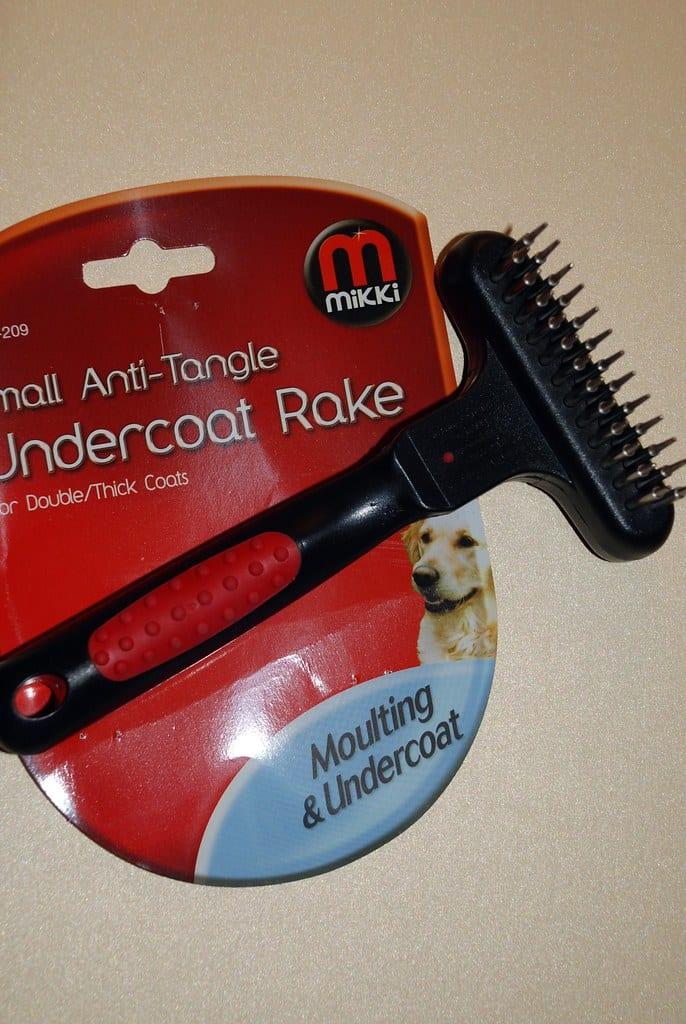
The reason to own this one is that dematting is never a standalone job — you find a mat while deshedding, deal with it, and carry on. Having the coarse side for the mat and the fine side for the surrounding coat in a single tool means you are not swapping hands mid-session on a dog that is already losing patience. The coarse side is less aggressive than a dedicated nine-blade dematter, which makes it the better choice on a thinner coat.
Cuts a set mat8.0
Control near skin8.5
Coat kept vs removed8.5
Comfort for the dog8.0
Value9.0
Overall8.4 / 10
What it gets right
+Two tools in one, and the two sides are genuinely for different jobs rather than marketing
+The 9-tooth side opens a real mat without you reaching for scissors
+Lightweight enough for a long coat-blow session without hand fatigue
What it gets wrong
−Both sides cut, so pressure control is on you
−Teeth are long enough to catch skin on a thin-coated dog
−Not a finishing tool
Who should skip itSkip it if your dog never mats — you only need the deshedding side, so buy that instead.
Dematting is damage control; this is prevention, and it belongs on this page because the mat you just spent twenty minutes on will be back in three weeks otherwise. A sparse slicker brushes the top third of a coat and leaves the layer at the skin untouched, and that untouched layer is where every mat begins. A dense pin bed engages the full depth of the coat on each stroke, which is what makes line brushing work.
Prevents new mats9.5
Control near skin9.0
Coat kept vs removed9.5
Comfort for the dog8.0
Value8.0
Overall8.8 / 10
What it gets right
+Pin density is the whole product: more pins means fewer passes through a curly coat
+The pins are long enough to reach skin on a doodle, which is where matting starts
+This is the brush that makes line brushing a doodle actually feasible
What it gets wrong
−Expensive for a brush, by a wide margin
−Dense pin bed is harder to clean out than a self-cleaning slicker
−Overkill on a short coat
Who should skip itSkip it if your dog has a short or smooth coat — you will never use the pin density you paid for.
Hold the hair between the mat and the skin with your free hand, then draw the blades through the mat’s outer edge in short strokes, away from the skin. Comb out what releases, then repeat a little deeper. You are splitting the mat into combable sections rather than removing it in one go.
+−Does a dematting tool hurt a dog?
It is uncomfortable, and it hurts if you pull. The pain comes from force travelling down matted hairs into the follicles, which is exactly what supporting the base with your free hand prevents. Short sessions, outer edge first, and a break every fifteen minutes keep it tolerable.
+−Should I bathe my dog before dematting?
No. Water swells and then tightens felted hair, so a mat that goes into a bath comes out smaller, harder and closer to the skin. Demat and comb out fully first, then bathe, then dry completely.
+−When should you cut a mat out instead?
When you cannot lift the mat away from the skin, when the skin underneath is red, damp or smelly, or when the matting covers a whole area rather than a patch. In those cases clipping under the mat with a short blade is faster and far kinder than hours of dematting.
How this page was put together
We define the coat problem the tool has to solve, shortlist products currently sold, compare the manufacturers’ documented specifications against what that coat actually needs, and cross-check against published findings from named sources. We do not test these tools on our own dogs under controlled conditions, and we will not say we do. Where a figure comes from a manufacturer, we name them; where it comes from someone else’s testing, we cite them. We print no prices — a stale number is worse than none. Read the full method.