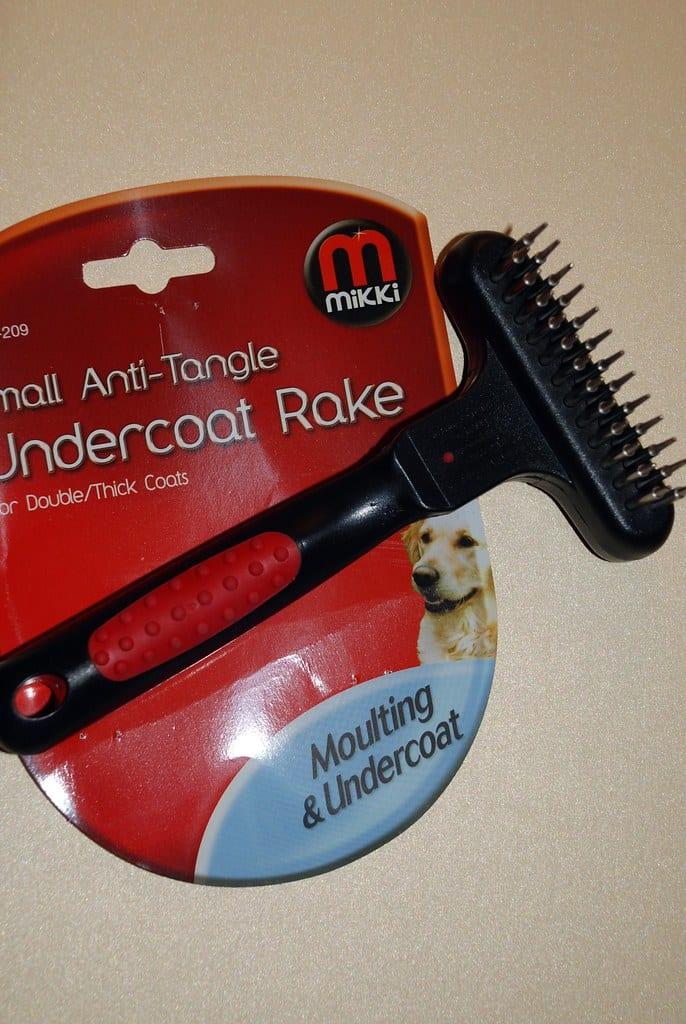
A rake is the most effective deshedding tool there is and the easiest one to use badly. Held at the wrong angle it stops lifting undercoat and starts scraping skin.
Scores are our own editorial assessment, not a product rating from reviews or testing. We do not print prices — every button goes to the current one on Amazon. #ad
The short answer
The short answer
Hold the rake almost flat against the coat, stroke with the grain in six-inch passes, and let the tool’s own weight do the work. Finish one hand-sized patch before moving on, and stop the session when the rake stops coming out loaded.
This page is for you if
You own an undercoat rake, or you are about to, and you want to use it without leaving the dog sore or the coat damaged.
You are on the wrong page if
Your dog’s coat is matted. A rake is the wrong tool for a mat and will tear it from the skin — start with the dematting guide.
What an undercoat rake is actually doing
A double-coated dog has two layers: long, coarse guard hairs on top, and a dense, soft undercoat beneath them that does the insulating. Only the undercoat sheds heavily, and it sheds in a seasonal drop rather than continuously. The problem is that the released undercoat cannot get out — it is trapped by the guard hairs above it, where it compacts, holds moisture and eventually felts into mats at the skin.
A rake has tines long enough and widely enough spaced to pass between the guard hairs, reach the trapped layer, and lift it out without cutting anything. That is the whole mechanism, and it explains both why a rake removes so much more hair than a brush and why it only works on a coat that has an undercoat to find. On a short slick coat or a doodle coat there is nothing down there and the tines simply scrape skin.
The angle is the whole technique
If you take one thing from this page, take the angle. Almost every complaint about rakes — the dog hates it, it scratches, it pulls, it does not pick anything up — traces back to holding the handle too high.
Handle angle
What the tines do
Result
Almost flat to the body
Tines slide between guard hairs and travel through the undercoat
Correct. Rake fills with loose hair, dog stands happily
Tipped up 30 degrees or more
Tine points angle down into the skin
Scraping. Pink skin, a dog that shifts away, little hair collected
Pressed down hard at any angle
Tines bottom out against skin and drag
Soreness and a dog that refuses the tool next time
Against the grain
Tines catch the guard coat and lever at the follicle
Pulling. Breaks guard hairs and hurts
Angle and outcome descriptions are this site's own, based on the tool geometry described in the rake sources cited below.
The test of a finished section: the rake comes out empty. That is when you move on, not when the dog complains.
The procedure
01
Check the coat is dry and mat-free
Run your hand through the coat against the grain. A solid lump is a mat and the rake must not go near it. Wet or damp hair stretches and breaks instead of releasing, so the coat has to be bone dry.
02
Set the dog up so it cannot wander
A non-slip surface, or a grooming table with a loop. A session runs fifteen to thirty minutes, and a dog free to walk off will make it twice that.
03
Hold the rake flat to the coat
The handle stays almost parallel to the dog's body so the tines enter at a shallow angle. Tipping the handle up drives the points into the skin.
04
Work with the grain, in short strokes
Stroke the way the coat lies, six to eight inches at a time, with no downward pressure. The tines should pass through the coat rather than drag against it.
05
Finish one section before moving on
Work a hand-sized patch until the rake stops coming out loaded, then move on and overlap slightly. Chasing hair around the dog produces a patchy result.
06
Work the heavy areas last
Rump, thighs and the back of the neck hold the most undercoat and are least sensitive. Leave the belly, armpits and groin to a brush rather than a rake.
07
Stop at the first sign of pink skin
Part the coat and look. Pink or warm skin means the tines have been reaching it, and the session is over regardless of how much undercoat is left.
Three places a rake should never go
The belly and groin, where the skin is thin and there is little coat to protect it. Over a bony prominence — hips, elbows, spine — where the tines have nowhere to go but into skin. And any mat, which a rake cannot pass through and will instead lever against the skin it is anchored to. Use a slicker or a comb in those places, and a dematter on the mat.
How often, and when it is worth it
Outside a coat drop, once a week on a double-coated dog keeps the undercoat clear. During a drop — typically spring and again in autumn — every other day for two to three weeks is not excessive, and you will be astonished at the volume. The coat tells you when: part it and look for a dull, fluffy layer standing away from the skin, or a dog that suddenly has visible tufts lifting on the flanks.
The single biggest improvement you can make to this routine is not a better rake. It is bathing and then blowing the coat out with a high-velocity dryer, which drives loose undercoat out from the skin upward and does in ten minutes what an hour of raking does. The blow-out procedure covers it, and the dryer roundup covers the machines. Rake first, bath, then blow out — in that order.
What to remember
What to remember
→Handle almost flat to the body. Steep angles scrape skin and collect nothing.
→With the grain, short strokes, no downward pressure. The tool's weight is enough.
→Finish a hand-sized section before moving on, then overlap slightly.
→Dry coat only. Wet hair stretches and snaps instead of releasing.
→Never over a mat, a bony prominence, the belly or the groin.
→Stop when the rake stops filling, or at the first hint of pink skin.
Two rows of rounded pins rather than blades, on a non-slip handle. Nothing on it is sharp, so a beginner's angle mistake does not cut the coat.
Double-row pin undercoat rake
Rows
Two rows of rounded pins
Pins
Rounded ends, not blades
Handle
Gripsoft non-slip
This is the rake to own while you are learning, because the failure mode is forgiving. Rounded pin ends cannot slice a guard hair or score skin the way a bladed rake can, so a slightly steep handle angle produces a dog that shifts its weight rather than a dog that yelps. The double row is genuinely useful: the first row separates the coat and the second lifts out of the gap, which is what clears loose hair instead of dragging it along the dog.
Forgiving of technique9.5
Undercoat lifted8.5
Coat safety9.5
Comfort for the dog9.0
Value9.0
Overall9.0 / 10
What it gets right
+Rounded pins, not blades — you cannot cut the coat with it, which makes it the safe default
+Double row doubles the undercoat it lifts per stroke
+Cheap enough to be nobody's agonizing decision
What it gets wrong
−Slower than a bladed tool on a heavy shed
−Pins will not open a set mat
−Handle is comfortable but the head is small for a giant breed
Who should skip itSkip it if you need to clear a felted mat — pins ride over it; you need a dematter.
On a Husky, Samoyed or Great Pyrenees in a seasonal coat drop, a fixed-tine rake pulls as much as it lifts, and that pulling is felt at the skin. Rotating tines turn as they meet resistance, so the tool releases the hair rather than tugging the follicle. Tine length is the other half: a deep double coat needs tines that reach under four inches of guard hair, and shorter tools simply comb the surface.
Forgiving of technique8.5
Undercoat lifted9.5
Coat safety9.0
Comfort for the dog9.0
Value9.0
Overall9.1 / 10
What it gets right
+Rotating tines slide through dense undercoat instead of ripping it, so the dog tolerates longer sessions
+Reaches deeper into a double coat than any slicker
+Does not cut, so you cannot thin the guard coat with it
What it gets wrong
−Slower than a bladed deshedder on short coats
−Tines can catch on a genuine mat and need working loose
−Does not finish — you still need a slicker and comb afterwards
Who should skip itSkip it on a short-coated dog — a bladed deshedder does that job far faster.
#adHow we earn · We never print a price we cannot verify
03
Best for coarse coats, and the one to be careful with
Mars Coat King undercoat rake
A bladed German rake sold in blade counts from coarse to fine, with the rule that a coarser coat takes fewer blades.
Bladed undercoat rake
Blade counts
Coarse (fewer blades) to fine (more blades)
Matching rule
Coarser coat takes fewer blades
Made in
Solingen, Germany
This is the rake professionals use on harsh and wire coats, and it is the one that punishes bad technique. The tines are blades, so they cut as well as lift — excellent for stripping dead coat out of a terrier jacket, unforgiving if you hold it at an angle or go over a strip repeatedly. Buy it only once your angle is reliable, and match the blade count to the coat: fewer blades for a coarse coat, more for a fine one.
Forgiving of technique5.5
Undercoat lifted9.0
Coat safety6.5
Comfort for the dog7.0
Value8.5
Overall7.8 / 10
What it gets right
+Strips dead undercoat faster than any brush, including on a wire coat where a slicker is useless
+Blade-count range means you can match the tool to the actual coat rather than hoping
+Replaceable, sharpenable blades
What it gets wrong
−It cuts. Used on a soft coat or with too much pressure it will thin the guard coat permanently
−Choosing the wrong blade count makes it either useless or destructive
−Not a finishing tool — you still need a brush and comb afterwards
Who should skip itSkip it on a doodle or any soft, curly coat — it damages what it is supposed to tidy.
#adHow we earn · We never print a price we cannot verify
FAQ
Questions people actually ask
+−How do you use an undercoat rake correctly?
Hold the handle almost flat against the dog so the tines enter the coat at a shallow angle, stroke with the grain in six-to-eight-inch passes, and apply no downward pressure. Work one hand-sized section until the rake stops filling, then move on. Stop the session if the skin looks pink.
+−Does an undercoat rake hurt a dog?
Not when it is held flat and used with the grain — most dogs enjoy it. It hurts when the handle is tipped up so the tine points reach the skin, when it is pressed down, or when it is dragged into a mat. If your dog objects, check your angle before blaming the tool.
+−How often should you use an undercoat rake?
Weekly on a double-coated dog outside a coat drop, and every other day for two to three weeks while the coat is actively dropping in spring or autumn. Daily use year-round is unnecessary and starts to thin the coat.
+−Can you use an undercoat rake on a wet dog?
No. Wet hair stretches to around one and a half times its length before breaking, so the tool snaps hairs that would have released cleanly from a dry coat. Rake before the bath, then dry the dog fully and finish with a brush.
How this page was put together
We define the coat problem the tool has to solve, shortlist products currently sold, compare the manufacturers’ documented specifications against what that coat actually needs, and cross-check against published findings from named sources. We do not test these tools on our own dogs under controlled conditions, and we will not say we do. Where a figure comes from a manufacturer, we name them; where it comes from someone else’s testing, we cite them. We print no prices — a stale number is worse than none. Read the full method.