About 30% more pins than a typical slicker, in three sizes. Pin density is the specification that decides whether a brush reaches the skin or skates over the top.
Long rotating tines that lift dead undercoat without cutting the guard coat. The tool for a long-coated German Shepherd, Collie or Great Pyrenees in spring.
Scores are our own editorial assessment, not a product rating from reviews or testing. We do not print prices — every button goes to the current one on Amazon. #ad
The short answer
The short answer
Start with the JW Gripsoft double-row undercoat rake: rounded pins long enough to reach through a long coat without cutting it. Add a dense slicker to get to the skin, and a dematter for the mats you will find on the way.
This page is for you if
Your dog has a coat longer than about two inches — a Collie, a long-coated German Shepherd, a Maltese, a Shih Tzu, a Bernese — and the loose hair is turning into tangles instead of landing on the floor.
You are on the wrong page if
Your dog has a curly doodle or poodle coat. That coat does not shed at all — the whole job is matting, so go to the doodle coat page instead.
On a long coat, shedding becomes matting
This is the single fact that changes the tool list. When a short-haired dog sheds, the hair falls out and lands somewhere. When a long-haired dog sheds, the released hair cannot escape — it is held in place by the length around it. It stays in the coat, works itself into a tangle with its neighbours, and within a couple of weeks that tangle has felted into a mat sitting against the skin.
So a long-coat session is never just deshedding. It is deshedding and detangling in the same pass, and the order matters: clear tangles first, then lift loose hair, then finish. Pick up a bladed deshedder and run it into a long coat the way you would on a Labrador and it will catch, stall, and tear hair out of the skin.
The four tools and the job each does
Tool
Job on a long coat
When to use it
Double-row pin rake
Reaches the bottom layer and lifts loose hair without cutting
First, over the whole dog, every session
Dense slicker brush
Works the coat to the skin and breaks up small tangles
Second, in sections, line brushing from the skin outward
Bladed dematter
Splits a felted mat so the rest can be combed out
Spot use only, on a mat, never as a general brush
Long-pin finishing brush
Lays the coat down and distributes oils without fraying ends
Last, and for daily maintenance between sessions
Rotating-tine rake
Clears heavy undercoat on a long DOUBLE coat in seasonal drop
Replaces the pin rake on Collies, long-coat GSDs, Bernese, Pyrs
Tool characteristics follow the manufacturer and review sources cited below; the sequence is this site's own.
Second tool, second pass: a dense slicker worked in sections is what reaches the skin on a long coat.
Line brushing is the technique that makes it work
Brushing the surface of a long coat produces a tidy-looking dog with mats underneath, and that is how most long-coated dogs end up being clipped off. Line brushing is the fix: you hold the coat up with one hand, work a horizontal line at the skin with the brush in the other, and let a little more coat down each time. You are brushing the bottom of the coat rather than the top.
It is slower and it is the only method that actually keeps a long coat. Fifteen minutes done this way beats an hour of surface brushing. The line brushing guide has the hand positions, and the deshedding procedure covers where it fits in the session.
Never deshed or demat a wet long coat
Wet hair stretches to roughly one and a half times its length before it breaks, which means a tool that would have released a tangle from a dry coat simply snaps the hairs instead. On a long coat that shows up as a dull, broken, shortening coat over a few months. Comb out fully before the bath, dry completely, and only then finish. The same applies to a damp dog on a humid day.
Where the mats will be
Long coats mat in predictable places because friction and moisture collect there. Check these every session, in this order: behind and under the ears; under a collar or harness; in both armpits; the groin and sanitary area; the backs of the thighs; between the foot pads; and the underside of the tail. If you find a mat, work it with a dematter from the outer edge inward — never pull at the base, which is attached to skin. The full procedure is on the dematting guide, and the ranked tools are on the dematting roundup.
What to remember
What to remember
→Loose hair in a long coat does not fall out — it felts. Deshedding and detangling are one job.
→Rounded pins over blades. A bladed deshedder in long hair catches and tears.
→Order: rake the whole dog, slicker in sections at the skin, demat spots, finish with long pins.
→Line brush. Surface brushing produces a tidy dog with mats underneath.
→Dry coat only. Wet hair stretches and snaps instead of releasing.
→Long double coat (Collie, long-coat GSD, Bernese)? Use the rotating-tine rake first.
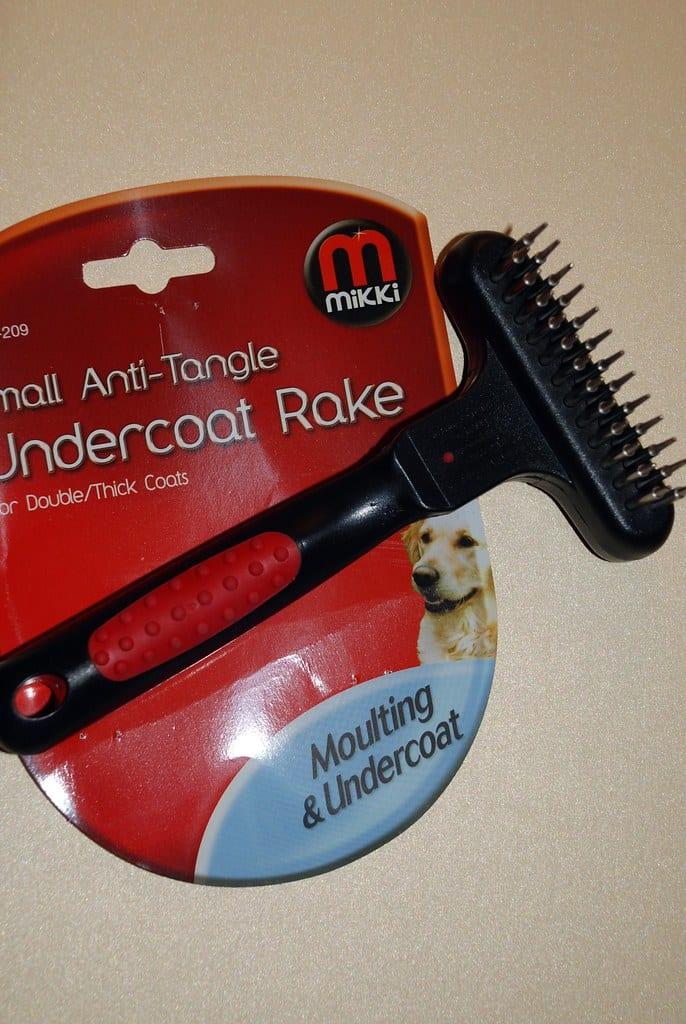
Two rows of rounded pins, not blades, on a non-slip handle. Long enough to reach through a long coat, blunt enough not to cut it.
Double-row pin undercoat rake
Rows
Two rows of rounded pins
Pins
Rounded ends, not blades
Handle
Gripsoft non-slip
The problem on a long coat is getting a tool to the bottom layer without cutting the coat you are trying to keep, and rounded pins are the answer. Two rows means the first row separates the coat and the second lifts out of the gap, which is what clears loose hair rather than dragging it along. Because nothing on it is sharp you can work the same area more than once without damage, and on a long coat you will need to.
Reach through a long coat9.0
Loose hair removed8.5
Coat safety9.5
Handles tangles8.0
Value9.0
Overall8.8 / 10
What it gets right
+Rounded pins, not blades — you cannot cut the coat with it, which makes it the safe default
+Double row doubles the undercoat it lifts per stroke
+Cheap enough to be nobody's agonizing decision
What it gets wrong
−Slower than a bladed tool on a heavy shed
−Pins will not open a set mat
−Handle is comfortable but the head is small for a giant breed
Who should skip itSkip it if you need to clear a felted mat — pins ride over it; you need a dematter.
About 30% more pins than a typical slicker, in three sizes. Pin density is the specification that decides whether a brush reaches the skin or skates over the top.
Professional slicker brush
Pins
Stainless steel, 27 mm long
Pin density
About 30% more pins than the maker's Big K brushes
Pad
Flexible cushion pad
Sizes
Large (3-3/4" x 3-3/4" head, 8" long), Medium (2-3/8" x 3-3/4", 7-3/8"), Baby G (2-3/8" x 2-3/8", 7-3/8")
A long coat hides its problems at the skin, and a sparse slicker never gets there — it combs the top third and leaves the rest. A dense bed engages the whole depth of the coat on each stroke, which is the difference between twenty minutes and an hour on the same dog. This is also the tool that makes line brushing possible, and line brushing is the technique that actually keeps a long coat out of trouble.
Reach through a long coat9.5
Loose hair removed8.5
Coat safety8.5
Handles tangles8.5
Value8.0
Overall8.8 / 10
What it gets right
+Pin density is the whole product: more pins means fewer passes through a curly coat
+The pins are long enough to reach skin on a doodle, which is where matting starts
+This is the brush that makes line brushing a doodle actually feasible
What it gets wrong
−Expensive for a brush, by a wide margin
−Dense pin bed is harder to clean out than a self-cleaning slicker
−Overkill on a short coat
Who should skip itSkip it if your dog has a short or smooth coat — you will never use the pin density you paid for.
You will find mats in a long coat — behind the ears, in the armpits, under a collar, down the backs of the thighs — and no amount of raking removes them. A dematter splits the mat into sections so the rest can be combed out, which is far kinder than pulling at it from the outside. Nine blades is the practical middle: enough to cut efficiently, not so many that the tool takes coat with it. Use it only on the mat, never as a general brush.
Reach through a long coat7.5
Loose hair removed6.0
Coat safety7.0
Handles tangles9.5
Value8.5
Overall8.0 / 10
What it gets right
+Nine curved blades cut a mat apart with far less pull on the skin than a comb would
+The right tool for an elderly dog whose skin will not tolerate tugging
+Compact enough for behind-the-ear and armpit mats
What it gets wrong
−It cuts coat permanently — the dematted area will look thinner
−Blades are sharp enough to cut you as well as the mat
−Not for routine brushing in any sense
Who should skip itSkip it for everyday maintenance — a dematter used weekly will wreck a coat.
Once the loose hair is out and the tangles are gone, a slicker is the wrong tool to keep using — its fine pins fray the ends of a long coat over time. A long-pin brush passes through the full depth without catching, lays the coat down, and distributes the oils that keep a long coat shiny instead of brittle. On a silky or long-coated dog this is the brush that does daily duty, with the rake and the slicker reserved for the weekly session.
Reach through a long coat8.0
Loose hair removed6.5
Coat safety9.5
Handles tangles6.0
Value8.0
Overall7.9 / 10
What it gets right
+Long pins pass through a long silky coat without the drag a slicker creates
+The correct finishing tool on a Maltese, Yorkie or show-coat Shih Tzu
+Professional-grade pin seating — the pins stay put
What it gets wrong
−A pin brush will not remove undercoat and should not be sold as if it does
−Does nothing for a mat
−Expensive for a brush with one job
Who should skip itSkip it on a double or curly coat — the pins skate over the surface and do nothing useful.
#adHow we earn · We never print a price we cannot verify
05
Best for a long double coat in full drop
FURminator dog grooming rake
Long rotating tines that lift dead undercoat without cutting the guard coat. The tool for a long-coated German Shepherd, Collie or Great Pyrenees in spring.
Rotating-tine undercoat rake
Tines
Rotating, long
Works on
Thick and double coats, longer hair
Action
Lifts dead undercoat without cutting the guard coat
Long-coated double breeds are a separate problem from long-coated silky breeds, and this is the tool for the first group. Rotating tines reduce the drag that makes a long coat pull at the skin, and the tine length gets under a guard coat that may be four inches deep. If your long-haired dog sheds in visible sheets twice a year rather than slowly matting, start here instead of with the pin rake.
Reach through a long coat9.0
Loose hair removed9.5
Coat safety9.0
Handles tangles7.0
Value9.0
Overall8.7 / 10
What it gets right
+Rotating tines slide through dense undercoat instead of ripping it, so the dog tolerates longer sessions
+Reaches deeper into a double coat than any slicker
+Does not cut, so you cannot thin the guard coat with it
What it gets wrong
−Slower than a bladed deshedder on short coats
−Tines can catch on a genuine mat and need working loose
−Does not finish — you still need a slicker and comb afterwards
Who should skip itSkip it on a short-coated dog — a bladed deshedder does that job far faster.
#adHow we earn · We never print a price we cannot verify
FAQ
Questions people actually ask
+−What is the best deshedding tool for long-haired dogs?
A double-row undercoat rake with rounded pins is the best first tool: long enough to reach the bottom of the coat, blunt enough not to cut it. On a long double coat in seasonal drop, a rotating-tine rake removes more. Bladed deshedders designed for short coats are the wrong tool on this coat.
+−Can you use an undercoat rake on a long-haired dog?
Yes, and it is usually the right choice — provided the pins are rounded rather than bladed and long enough to pass through the coat. Work in small sections, comb tangles out first, and never force the rake through a mat.
+−How do I stop my long-haired dog from matting?
Line brush to the skin two or three times a week rather than brushing the surface daily, and check the seven places mats start: behind the ears, under the collar, both armpits, the groin, the backs of the thighs, between the pads and under the tail. Mats found at a week old comb out; mats found at a month old get cut out.
+−Should I bathe my dog before or after deshedding?
Comb and deshed before the bath, then dry fully and finish with the long-pin brush. Wet long hair stretches and breaks rather than releasing, and a mat that goes into a bath comes out tighter than it went in.
How this page was put together
We define the coat problem the tool has to solve, shortlist products currently sold, compare the manufacturers’ documented specifications against what that coat actually needs, and cross-check against published findings from named sources. We do not test these tools on our own dogs under controlled conditions, and we will not say we do. Where a figure comes from a manufacturer, we name them; where it comes from someone else’s testing, we cite them. We print no prices — a stale number is worse than none. Read the full method.