Skip to content
Clip & Coat

Guides

Dog Grooming Starter Kit: What to Buy First

Buy in this order and nothing is wasted. The clipper goes near the end of the list, which is the opposite of how most people do it.

By Brijon M.
A set of dog grooming tools laid out on a bench

Quick picks

The shortlist

Quick picks

Tap any row to jump to that pick’s full write-up. The price column goes straight to Amazon.

#ProductBest forScorePrice
1
A slicker brush with fine bent pins

Chris Christensen Big G slicker brush

The slicker brush that does the job preventing every expensive problem downstream.

Purchase one, for every coat that grows8.9
2
A cordless rotary tool of the kind used to grind dog nails

Dremel PawControl 7760-PGK

Nails need doing every two to four weeks regardless of coat type, and this does them safely.

Purchase two, for every dog on earth8.6
3
A forced-air dryer nozzle directed at a damp coat

XPOWER B-55

Real airflow at the entry price - the tool that gates clipping and brushing both.

Purchase three, if the coat is thick or curly7.9
4
A detachable-blade animal clipper resting on a work surface

Andis UltraEdge AGC Super 2-Speed

When you do buy a clipper, this is the one that does not need replacing.

Purchase five, and only if the coat actually grows8.4

Scores are our own editorial assessment, not a product rating from reviews or testing. We do not print prices — every button goes to the current one on Amazon. #ad

The buying order

The short answer

Brush and comb first, nail tool second, dryer third, table fourth, clipper and blades last. The clipper is late because two of the five coat types should never be clipped and a third barely needs it — whereas every dog needs its nails done and every growing coat needs brushing to the skin.

Most people buy this list backwards, starting with a clipper kit because that is what “grooming equipment” looks like in a shop. The result is a cupboard with an unused clipper and a dog with matted ears, because the tools that prevent problems were never bought. The order below is by return per dollar, which is a different ranking from price.

The list, in order

#ItemWho needs itWhy here
1Slicker brush + steel combEvery coat that grows or matsPrevents the most expensive problem there is. Cheap, daily, decisive
2Nail grinder or clipper + styptic powderEvery dogFortnightly need, low cost, health rather than cosmetic
3High-velocity dryerDouble and curly coatsGates clipping and brushing; doubles as the best deshedding tool
4Grooming table + armAnyone doing a full groomMakes a two-hour job possible. Bought last by most, should be fourth
5Clipper + 2 extra bladesGrowing coats onlyLargest outlay, narrowest applicability
6Blunt-tipped scissors + small trimmerGrowing coatsFace, feet and sanitary work a body clipper cannot do
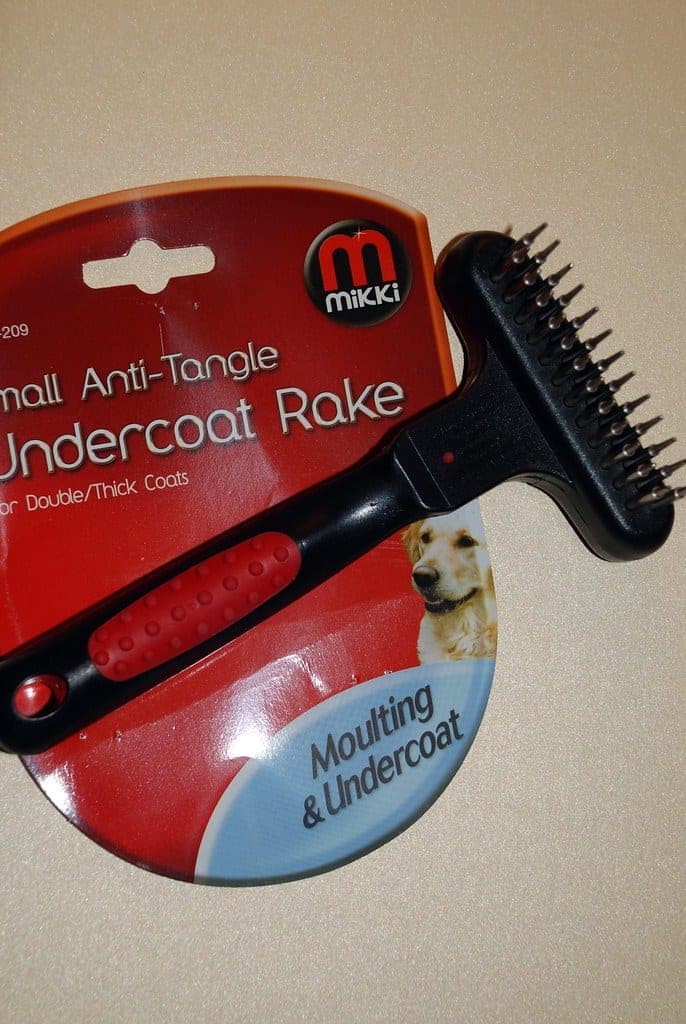
7Undercoat rakeDouble coats (instead of 5 and 6)For a shedding coat this replaces the whole clipper line

By coat type

Doodle, poodle, Bichon. Items 1, 2, 3, 4, 5, 6 — the full list. This is the most demanding coat and the most expensive kit, and also the one where home grooming saves the most. Start with 1 and 2 today; 3 before your first clip.

Double coat (Husky, Shepherd, Golden, Samoyed, Pyrenees). Items 7, 2, 3 and 1. No clipper. A rake, a nail tool, a dryer and a slicker is the entire kit, and it is cheaper than the doodle list by a wide margin. See the double coat page for why the clipper is absent.

Silky long coat (Yorkie, Maltese, Shih Tzu). Items 1, 2, 6 and a low-airflow dryer or a gentler setting. A pin brush as a finishing tool is a worthwhile addition here, which it is not on most coats.

Wire coat (Schnauzer, terriers). Items 2 and 1, plus a stripping knife and a carding tool instead of a clipper — unless you have decided to accept a softer, paler coat. The trade-off is on stripping versus clipping.

Short smooth coat. Item 2, and a rubber mitt. That is genuinely the whole list, and anyone selling you more than that for a Beagle is selling you something you do not need.

What to skip

  • Twelve-piece kits. Usually one mediocre clipper and eleven things you will throw away — blunt scissors, a comb that bends, plastic guide combs that pop off. Buy fewer, better items.
  • A second clipper “for the face” before you own a trimmer. A trimmer is a different tool, not a smaller clipper. One of each, eventually; not two clippers.
  • A deshedding blade on a doodle. There is no undercoat to remove and it will cut the coat. See FURminator versus slicker.
  • A grooming vacuum, unless your dog sheds heavily onto carpet. It captures hair rather than removing more of it, which is a tidiness benefit with a narrow audience.
  • Heated dryers with a thermostat element. Unnecessary and a burn risk. Moving air does the work.
  • Anything labeled “professional” with no specifications published. If the manufacturer will not state the airflow, the motor type or the blade standard, there is usually a reason.

Clippers ship with one blade. A groom on a doodle needs a body blade and a short blade, and a second body blade to swap to when the first gets hot is how professionals avoid stopping. Discovering this mid-groom is the most common first-clip frustration, and it is entirely avoidable.

What to remember

  • Brush and comb, nail tool, dryer, table, clipper, scissors. In that order.
  • Every dog needs a nail tool. Only growing coats need a clipper.
  • Double coats need a rake and a dryer, and no clipper at all.
  • Short coats need a nail tool and a mitt. Nothing else.
  • Skip 12-piece kits — one mediocre clipper and eleven throwaways.
  • Buy the second blade with the clipper, not after the first groom.
The picks in full

Every pick, in order

01

Purchase one, for every coat that grows

Chris Christensen Big G slicker brush

The slicker brush that does the job preventing every expensive problem downstream.

A slicker brush with fine bent pins

Professional slicker brush

Pin density
About 30% more pins than a typical slicker
Sizes
Three
Best for
Doodles, poodles and long-coated breeds

Specs: Chris Christensen — Big G vs Big K slicker brushes

Nothing on this list returns more per dollar. Line brushing to the skin every day or two is what prevents matting, and matting is the most expensive thing that happens to a growing coat. Flexible, well-finished pins are what make a daily tool comfortable rather than something the dog learns to resist. Pair it with a steel comb to verify your work.

Buy-first priority9.5
Reach to the skin9.0
Comfort for the dog9.0
Build quality8.5
Value7.0
Overall8.9 / 10

What it gets right

  • Pin density is the whole product: more pins means fewer passes through a curly coat
  • The pins are long enough to reach skin on a doodle, which is where matting starts
  • This is the brush that makes line brushing a doodle actually feasible

What it gets wrong

  • Expensive for a brush, by a wide margin
  • Dense pin bed is harder to clean out than a self-cleaning slicker
  • Overkill on a short coat

Who should skip itSkip it if your dog has a short or smooth coat — you will never use the pin density you paid for.

Check price on Amazon

#ad How we earn · We never print a price we cannot verify

02

Purchase two, for every dog on earth

Dremel PawControl 7760-PGK

Nails need doing every two to four weeks regardless of coat type, and this does them safely.

A cordless rotary tool of the kind used to grind dog nails

Cordless variable-speed nail grinder

Speed range
8,000 – 25,000 RPM
Power
Cordless, rechargeable
Torque
More than most budget pet grinders
Best for
Medium and large dogs, thick nails

Specs: Dogster — Best Dog Nail Grinders

Every dog needs its nails done, including the ones that need nothing else from this site. A grinder removes nail gradually so you get many chances to stop before the quick, which is why it suits thick and dark nails. Standard replaceable drums mean the tool lasts a dog's lifetime.

Buy-first priority9.0
Control near the quick9.5
Thick-nail capability9.0
Noise and vibration6.5
Value7.0
Overall8.6 / 10

What it gets right

  • It is a Dremel rotary tool, so it has torque a pet-branded grinder does not — thick nails do not stall it
  • The speed range means you can start slow on a dog that hates the noise
  • Grinds rather than crushes, so there is no split-nail risk

What it gets wrong

  • At 25,000 RPM it generates heat fast; you must pulse, not dwell
  • Louder and more vibration than a low-RPM pet grinder
  • Guard attachment is fiddly and most people stop using it

Who should skip itSkip it for a tiny, noise-phobic dog — the RPM and vibration are more than the job needs.

Check price on Amazon

#ad How we earn · We never print a price we cannot verify

03

Purchase three, if the coat is thick or curly

XPOWER B-55

Real airflow at the entry price - the tool that gates clipping and brushing both.

A forced-air dryer nozzle directed at a damp coat

Single-motor high-velocity dryer

Motor
Single
Positioning
Best single-motor value in high-velocity dryers
Controls
Variable speed

Specs: Pawster — Best High Velocity Dog Dryers

This is the purchase people defer and should not. A coat that is damp at the skin will not clip cleanly and will not brush out, so a dryer unlocks both of the jobs after it. It is also the most effective deshedding tool for a double coat. Variable speed for introducing it to a dog, and small enough to store.

Buy-first priority8.0
Airflow7.5
Noise6.5
Storage footprint8.5
Value9.0
Overall7.9 / 10

What it gets right

  • The sensible first force dryer: real airflow at a price that is not a professional outlay
  • Variable speed lets you start low on a dog that has never met a force dryer
  • Compact enough to store in a cupboard

What it gets wrong

  • Single motor, so a soaked giant breed takes noticeably longer
  • Hose and nozzle set is basic
  • Still loud — quieter than a twin-motor, not quiet

Who should skip itSkip it if you are drying a Great Pyrenees weekly — buy the airflow, not the price.

Check price on Amazon

#ad How we earn · We never print a price we cannot verify

04

Purchase five, and only if the coat actually grows

Andis UltraEdge AGC Super 2-Speed

When you do buy a clipper, this is the one that does not need replacing.

A detachable-blade animal clipper resting on a work surface

Corded detachable-blade clipper

Speeds
3,400 / 4,400 SPM
Motor
Rotary, corded
Blade system
Detachable A5 (UltraEdge / CeramicEdge / ShowEdge)
Cord
14 ft heavy-duty
Weight
17.6 oz
Housing
Vent-free, no cooling fan to clog

Specs: Andis — UltraEdge AGC Super 2-Speed product listing

The clipper is late on this list because two of the five coat types should never be clipped and a third barely needs it. If yours does, buy properly: a vent-free rotary machine that will not clog on dense coat, on the A5 blade standard so the blades survive any future upgrade. Budget for two more blades on top of the one in the box.

Buy-first priority6.0
Torque under load9.0
Blade system9.5
Heat management9.0
Value8.5
Overall8.4 / 10

What it gets right

  • Two usable speeds rather than one compromise speed — 3,400 SPM for bulk removal, 4,400 for finish work
  • Takes the whole A5 detachable blade range, so one clipper covers every coat length you will ever need
  • The vent-free housing is the reason it survives doodle coats: there is no fan intake for undercoat to pack into
  • 14 ft cord means you are not fighting an extension lead around a grooming table

What it gets wrong

  • Corded, so you work around a cable with a dog that may not stand still
  • Ships with one blade; a doodle or double coat needs at least two more, which is a real added cost
  • Heavier in the hand than a cordless unit over a long session

Who should skip itSkip it if you own one short-coated small dog — this is more clipper than that coat will ever need.

Check price on Amazon

#ad How we earn · We never print a price we cannot verify

Read the full Andis UltraEdge AGC Super 2-Speed review

FAQ

Questions people actually ask

Can I start with just one tool?

Yes — a slicker brush if your dog’s coat grows, a nail tool if it does not. Those are the two items that address a real recurring need for the least money, and neither commits you to anything else.

Are all-in-one grooming kits worth it?

Rarely. The clipper in the box is usually the cheapest part and the accessories are padding. The exception is a vacuum-based kit for a heavy-shedding dog, where the canister and suction are the actual product.

Do I really need a grooming table?

Not to start, and it will improve your results more than any other upgrade once you are doing full grooms. A dog that cannot wander is easier and safer to work on than the same dog on the floor — see how to use a grooming table.

How many blades do I need?

Two to start: a #4F or #5F for the body and a #10 for sanitary areas. A second body blade to swap to when the first gets hot is the next addition. The numbering is explained on the blade size chart.

How this page was put together

We define the coat problem the tool has to solve, shortlist products currently sold, compare the manufacturers’ documented specifications against what that coat actually needs, and cross-check against published findings from named sources. We do not test these tools on our own dogs under controlled conditions, and we will not say we do. Where a figure comes from a manufacturer, we name them; where it comes from someone else’s testing, we cite them. We print no prices — a stale number is worse than none. Read the full method.

Sources

  1. 01GroomBoard — clippers professional groomers use
  2. 02Pet Groomer Hub — grooming tables compared