Skip to content
Clip & Coat

Deshedding & Dematting

Best Deshedding Tools for Dogs

Four tool categories that look interchangeable and are not. Using the wrong one does nothing at best and permanent damage at worst.

By Brijon M.
An undercoat rake pulling loose undercoat from a dense coat

Quick picks

The shortlist

Quick picks

Tap any row to jump to that pick’s full write-up. The price column goes straight to Amazon.

#ProductBest forScorePrice
1
An undercoat rake pulling loose undercoat from a dense coat

FURminator deShedding tool

On a coat that sheds rather than mats, nothing removes more loose undercoat per minute.
Best for short and medium coats7.9
2
An undercoat rake pulling loose undercoat from a dense coat

FURminator dog grooming rake

Rotating tines that reach into a double coat and cannot cut the guard hairs.

Best for thick double coats9.0
3
An undercoat rake pulling loose undercoat from a dense coat

Maxpower Planet pet grooming rake

Nine teeth one side for mats, seventeen the other for thinning. Two genuinely different jobs.

Best for a coat that both sheds and mats8.2
4
An undercoat rake pulling loose undercoat from a dense coat

JW Pet Gripsoft double-row undercoat rake

Rounded pins, not blades. You physically cannot damage the coat with it.

Safest tool for a beginner8.4
5
An undercoat rake pulling loose undercoat from a dense coat

SleekEZ deshedding brush

Gentle enough to use every few days, which matters more than peak hair removal.

Best for regular maintenance7.9

Scores are our own editorial assessment, not a product rating from reviews or testing. We do not print prices — every button goes to the current one on Amazon. #ad

The four tools, and which is which

The short answer

A deshedder has a fine bladed edge for short-to-medium shedding coats. A rake has long tines for dense double coats. A slicker has fine bent pins for curly and long coats that mat. A dematter has curved blades for cutting a set mat apart. Using one in another’s place is the commonest mistake in home grooming.

CoatRight toolWrong tool, and why
Short, sheds (Labrador, beagle)Bladed deshedderSlicker — nothing to lift
Double, sheds heavily (husky, shepherd)Undercoat rake + dryerDeshedder — cuts the guard coat
Curly, mats (doodle, poodle)Dense slicker + combDeshedder — no undercoat to shed
Long silky (Maltese, Yorkie)Pin brush + combRake — tears a single coat
Wire (schnauzer, terrier)Stripping knife or bladed rakeSlicker — softens the jacket

Published distinction: a deshedding tool's fine close-set edge suits short-to-medium coats; rakes suit longer and double-coated breeds (sources below).

This page is for you if

Your dog leaves hair everywhere and you want to remove it at source rather than vacuuming it up. Find the coat type first on grooming by coat type.

You are on the wrong page if

Your dog does not shed but gets knots and tangles. That is matting, not shedding — go to slicker brushes and dematting tools.

Used with pressure, used too often, or used on the wrong coat, a bladed deshedding tool cuts the guard hairs that give a coat its texture and weather resistance. Light pressure, in the direction the coat grows, and not more than once a week outside a shed. If the tool is coming away with long coarse hairs rather than soft fluff, stop.

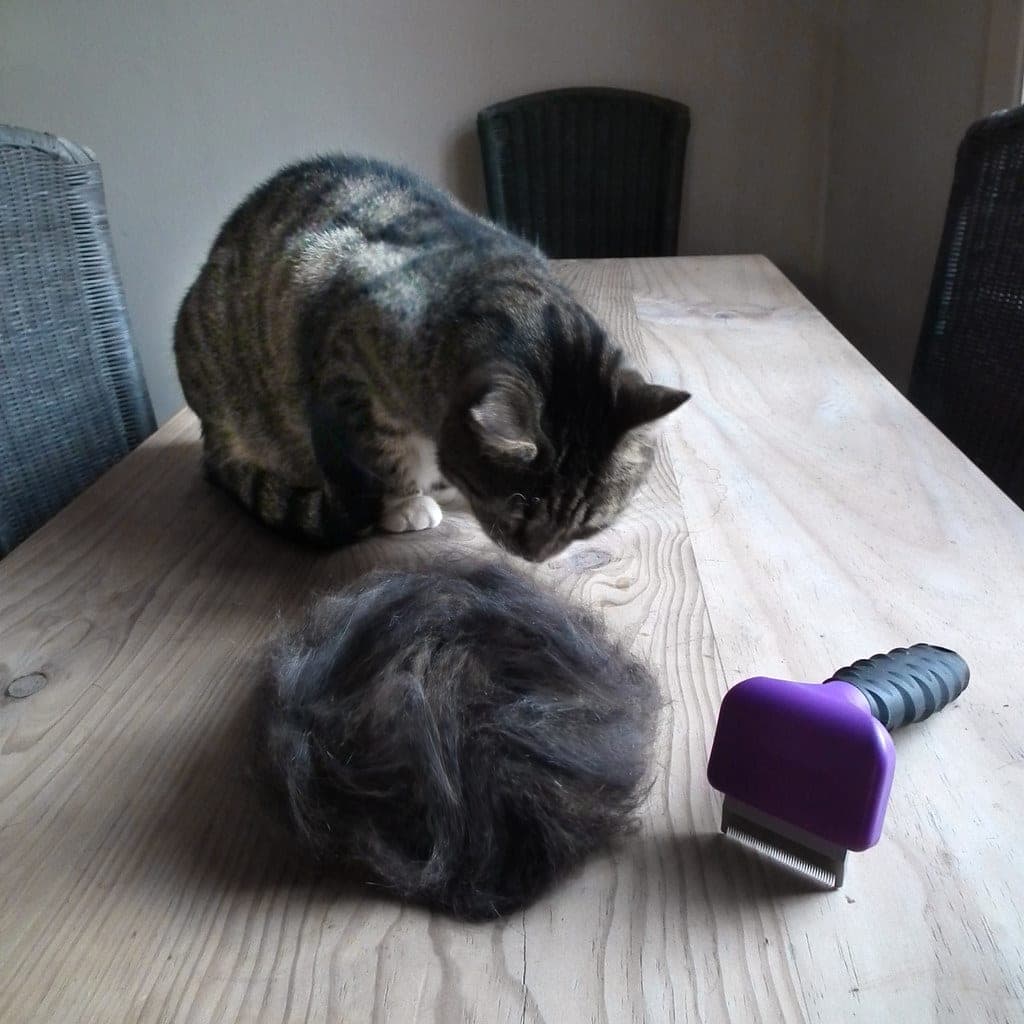
A pile of loose undercoat removed during a deshedding session
Soft fluff is undercoat and should be coming out. Long coarse hairs are guard coat and should not be.

Deshedding is faster with water and air

A bath loosens undercoat; a high-velocity dryer blows it free from the skin. Bathe, blow out, then rake while the coat is still slightly damp, and a session removes several times what dry brushing does. On a double coat during a coat blow this is the difference between two sessions and six weeks — see how to blow out a double coat.

How often

Weekly for most shedding coats, every two or three days during a coat blow, and daily for a few weeks if you have let it get ahead of you. The full schedule by coat type is on the grooming schedule.

The picks in full

Every pick, in order

01

Best for short and medium coats

FURminator deShedding tool

On a coat that sheds rather than mats, nothing removes more loose undercoat per minute.

An undercoat rake pulling loose undercoat from a dense coat

Bladed deshedding tool

Edge
Fine, close-set stainless edge
Works on
Short-to-medium coats, close to the skin
Sizes
Short-hair and long-hair variants per dog size
Feature
FURejector release button

Specs: Furric — Best Deshedding Tool

The fine, close-set stainless edge catches loose undercoat right at the skin, which is why it feels dramatic the first time you use it on a Labrador. Two things decide whether you get that result: buying the variant matched to your dog's size AND coat length, and accepting that it is a blade — used with pressure or too often it thins and cuts the guard coat. The release button genuinely speeds up a big shed-out.

Hair removed per minute9.5
Safety on the guard coat6.0
Works on long coat5.5
Comfort for the dog7.5
Value8.0
Overall7.9 / 10

What it gets right

  • On a short or medium coat it removes more loose undercoat per minute than anything else
  • The release button genuinely speeds up a big shed-out
  • Buying the right size-and-length variant makes a bigger difference than people expect

What it gets wrong

  • It is a blade. Over-used or used with pressure it thins and cuts the guard coat
  • The wrong variant for your coat length does nothing or does damage
  • Useless on a curly or felted coat

Who should skip itSkip it on a doodle, poodle or any coat that mats rather than sheds — it is the wrong category of tool.

Check price on Amazon

#ad How we earn · We never print a price we cannot verify

Read the full FURminator deShedding tool review

02

Best for thick double coats

FURminator dog grooming rake

Rotating tines that reach into a double coat and cannot cut the guard hairs.

An undercoat rake pulling loose undercoat from a dense coat

Rotating-tine undercoat rake

Tines
Rotating, long
Works on
Thick and double coats, longer hair
Action
Lifts dead undercoat without cutting the guard coat

Specs: Furric — Best Deshedding Tool

On a long or double coat the bladed deshedder is the wrong shape, and this is the right one: long rotating tines that slide through dense undercoat rather than ripping it. Because it does not cut, you cannot thin the guard coat with it — which makes it the safe default for a husky, shepherd or retriever. Slower than a bladed tool on short coat, and it will not open a true mat.

Hair removed per minute8.0
Safety on the guard coat10.0
Works on long coat9.5
Comfort for the dog9.0
Value9.0
Overall9.0 / 10

What it gets right

  • Rotating tines slide through dense undercoat instead of ripping it, so the dog tolerates longer sessions
  • Reaches deeper into a double coat than any slicker
  • Does not cut, so you cannot thin the guard coat with it

What it gets wrong

  • Slower than a bladed deshedder on short coats
  • Tines can catch on a genuine mat and need working loose
  • Does not finish — you still need a slicker and comb afterwards

Who should skip itSkip it on a short-coated dog — a bladed deshedder does that job far faster.

Check price on Amazon

#ad How we earn · We never print a price we cannot verify

03

Best for a coat that both sheds and mats

Maxpower Planet pet grooming rake

Nine teeth one side for mats, seventeen the other for thinning. Two genuinely different jobs.

An undercoat rake pulling loose undercoat from a dense coat

Dual-sided dematting and thinning rake

Coarse side
9 teeth — stubborn mats
Fine side
17 teeth — thinning the undercoat
Build
Lightweight, non-slip handle

Specs: Naming Pet — Best Undercoat Rakes

Published as the value pick, and the dual-sided design is not marketing: the 9-tooth side opens a stubborn mat and the 17-tooth side thins out loose undercoat. For the common real-world case — a long-coated dog that sheds AND gets the occasional felted patch — it covers both without buying two tools. Both sides cut, so pressure control is on you.

Hair removed per minute8.5
Safety on the guard coat6.5
Works on long coat9.0
Comfort for the dog7.5
Value9.5
Overall8.2 / 10

What it gets right

  • Two tools in one, and the two sides are genuinely for different jobs rather than marketing
  • The 9-tooth side opens a real mat without you reaching for scissors
  • Lightweight enough for a long coat-blow session without hand fatigue

What it gets wrong

  • Both sides cut, so pressure control is on you
  • Teeth are long enough to catch skin on a thin-coated dog
  • Not a finishing tool

Who should skip itSkip it if your dog never mats — you only need the deshedding side, so buy that instead.

Check price on Amazon

#ad How we earn · We never print a price we cannot verify

04

Safest tool for a beginner

JW Pet Gripsoft double-row undercoat rake

Rounded pins, not blades. You physically cannot damage the coat with it.

An undercoat rake pulling loose undercoat from a dense coat

Double-row pin undercoat rake

Rows
Two rows of rounded pins
Pins
Rounded ends, not blades
Handle
Gripsoft non-slip

If you are not confident about pressure, this is where to start. Two rows of rounded pins lift loose undercoat with no cutting edge anywhere, so the worst outcome is that it does not remove as much as a bladed tool. It is cheap, it is nobody's agonizing decision, and it will not ruin a coat while you learn what your dog's coat actually needs.

Hair removed per minute7.0
Safety on the guard coat10.0
Works on long coat8.0
Comfort for the dog9.0
Value9.5
Overall8.4 / 10

What it gets right

  • Rounded pins, not blades — you cannot cut the coat with it, which makes it the safe default
  • Double row doubles the undercoat it lifts per stroke
  • Cheap enough to be nobody's agonizing decision

What it gets wrong

  • Slower than a bladed tool on a heavy shed
  • Pins will not open a set mat
  • Handle is comfortable but the head is small for a giant breed

Who should skip itSkip it if you need to clear a felted mat — pins ride over it; you need a dematter.

Check price on Amazon

#ad How we earn · We never print a price we cannot verify

Read the full JW Pet Gripsoft double-row undercoat rake review

05

Best for regular maintenance

SleekEZ deshedding brush

Gentle enough to use every few days, which matters more than peak hair removal.

An undercoat rake pulling loose undercoat from a dense coat

Wave-blade deshedding brush

Edge
Wave-patterned blade on a wooden block
Action
Lifts loose surface hair without digging
Best for
Ongoing maintenance between full sessions

Specs: Naming Pet — Best Undercoat Rakes

The tool that gets used beats the tool that removes most. A wave-patterned blade on a wooden block with no moving parts lifts loose surface hair without digging, which means you can run it over the dog every couple of days without worrying. It will not reach deep undercoat on a dense double coat, so it is the maintenance tool rather than the coat-blow tool.

Hair removed per minute6.5
Safety on the guard coat8.5
Works on long coat6.0
Comfort for the dog9.5
Value9.0
Overall7.9 / 10

What it gets right

  • Gentle enough for regular use, which matters more than peak hair removal
  • No moving parts and nothing to break
  • Works dry on a dog that hates bath time

What it gets wrong

  • Does not reach deep undercoat on a dense double coat
  • Wooden block is not washable
  • One size does not fit a Chihuahua and a Samoyed equally

Who should skip itSkip it as your main tool during a coat blow — it will not keep up with the volume.

Check price on Amazon

#ad How we earn · We never print a price we cannot verify

FAQ

Questions people actually ask

What is the best way to deshed a dog?

Bathe, dry with a force dryer to blow the undercoat free, then rake it out while slightly damp. That sequence removes far more than dry brushing. Full method: how to deshed a dog.

Does a FURminator cut the coat?

It has a blade, so yes, it can — that is what it is for on undercoat, and it is why pressure and frequency matter. Light strokes in the direction the coat grows, and the right variant for the coat length. Full comparison with a rake on FURminator vs undercoat rake.

How often can I use a deshedding tool?

Once a week normally; every couple of days during a shed. More often than that with a bladed tool and you start thinning the coat rather than removing dead hair.

Will deshedding stop my dog shedding?

No, but it moves the hair from your sofa to your bin. The hair is coming out either way; the only question is whether you remove it on a schedule or find it everywhere.

Should I deshed a doodle?

No — a doodle has little or no undercoat to shed, so a deshedding tool has nothing to remove and will cut the coat. Doodles need a dense slicker and a comb, not a deshedder.

How this page was put together

We define the coat problem the tool has to solve, shortlist products currently sold, compare the manufacturers’ documented specifications against what that coat actually needs, and cross-check against published findings from named sources. We do not test these tools on our own dogs under controlled conditions, and we will not say we do. Where a figure comes from a manufacturer, we name them; where it comes from someone else’s testing, we cite them. We print no prices — a stale number is worse than none. Read the full method.

Sources

  1. 01Furric — Best Deshedding Tool (FURminator tool and rake positioning)
  2. 02Naming Pet — Best Undercoat Rakes (Maxpower Planet tooth counts, Andis dematter)
  3. 03BDPets — Best Deshedding Tools for Double Coated Dogs