Both are blade-edge deshedders and they are not interchangeable. One reaches down into the undercoat; the other deliberately does not. Pick by how deep the loose hair sits.
Scores are our own editorial assessment, not a product rating from reviews or testing. We do not print prices — every button goes to the current one on Amazon. #ad
The short answer
The short answer
Use a FURminator when the loose hair is undercoat you cannot reach — short and medium double coats. Use a SleekEZ when the loose hair is sitting on the surface, or when the dog objects to a deeper tool. On a thick double coat, buy an undercoat rake instead of either.
This page is for you if
You are down to these two tools, you have read conflicting things about whether the FURminator damages a coat, and you want to know which edge is right for your dog.
You are on the wrong page if
Your dog mats rather than sheds — a doodle, poodle or silky coat. Neither tool is for you; go to slicker brushes instead.
The difference is edge geometry, not brand
Both of these are blade tools rather than brushes, which is why they get compared in the first place. Neither has pins. Both work by presenting a metal edge to the coat and dragging loose hair out against it. What separates them is the shape of that edge, and the shape decides how deep the tool goes.
The FURminator edge is a fine, closely spaced comb — in practice a short blade with many narrow teeth. Those teeth are fine enough to pass between the guard hairs and engage the softer undercoat below, which is exactly why it brings out so much hair. The SleekEZ edge is a wave pattern milled into a bar: broad, shallow and not designed to penetrate. It catches hair that has already released and is sitting in the coat waiting to fall.
That is the whole comparison. Ask where your dog’s loose hair is, and the tool chooses itself.
Side by side
FURminator deShedding tool
SleekEZ deshedding brush
Edge type
Fine, close-set stainless comb edge
Wave-patterned blade on a wooden block
Working depth
Through the guard coat into the undercoat
At and just below the coat surface
Best coat
Short to medium, with undercoat
Short and slick, or light maintenance on any coat
Volume removed
High in one session
Moderate, suited to frequent short sessions
Risk of cutting guard hairs
Real, if you use pressure or repeat a strip
Low — the edge does not penetrate
Hair release
FURejector button clears the edge
Wipe or tap the bar clear
Sizes
Short-hair and long-hair variants by dog size
Several bar widths
Works on a thick double coat
Partly — struggles to reach the bottom layer
No — stays at the surface
Specifications are the manufacturer and review-source figures cited below; depth and coat-suitability judgements are this site's own.
Pick the FURminator if
→Your dog is short or medium-coated with a soft layer underneath — Lab, Beagle, Corgi, smooth Aussie.
→You want one substantial session a month rather than frequent short ones.
→The hair you are fighting comes out in clumps when you pull gently at the coat.
→You are disciplined about light pressure and single passes.
Pick the SleekEZ if
→Your dog is slick-coated with little real undercoat — Boxer, Staffie, Dachshund.
→Your dog flinches, snaps or walks off when a deeper tool goes in.
→You would rather do five minutes twice a week than a long session.
→You are worried about damaging the guard coat and want the safer edge.
The third answer: if the coat is thick and double, a rake with long tines beats either blade tool.
Does a FURminator damage the coat?
Used as intended, no. Used the way most people use it, sometimes. The edge cuts, and that is not a defect — it is how it clears hair that is tangled rather than merely loose. The problem is pressure and repetition: pressing down drives the teeth into the guard layer, and running the same strip eight times takes healthy hair once the dead hair is gone.
Three rules keep it honest. Let the weight of the tool do the work and never push. Make one or two passes over a strip, then move on. Stop when the tool stops filling. If you follow those, the coat stays intact; if you treat it as a scrubbing brush, you will see thinning and dull patches within a couple of months. The same logic applies to every bladed deshedder, which is why the rake comparison exists as a separate page.
Neither tool belongs on a matted coat
A blade-edge deshedder dragged into a mat will either stop dead or tear the mat out of the skin, and both hurt. Mats come out with a dematter or a comb worked from the outside edge inward — see the dematting procedure and the dematting tools. Deshed afterwards, never before.
What to do if you own both
They layer rather than compete. The sensible routine on a short double coat is the SleekEZ for weekly maintenance, keeping the surface clear, and the FURminator once a month or during a coat drop, when there is genuinely a volume of undercoat to remove. Running the deep tool weekly is how coats get thinned; running only the shallow tool during a coat drop is how you end up vacuuming every day.
What to remember
→Edge depth is the whole difference: FURminator reaches undercoat, SleekEZ works the surface.
→Light pressure, one or two passes, stop when the tool stops filling. That applies to both.
→Thick or long double coat (Husky, Samoyed, Pyr)? Buy a rake instead of either of these.
→Matted coat? Demat first. A deshedder in a mat tears the skin.
→Deshed a dry coat. Wet hair stretches and breaks instead of releasing.
→A force dryer after a bath removes more undercoat than either tool, on any double coat.
The FURminator works because its edge is fine enough to slide between guard hairs and catch the loose undercoat underneath, which is the layer a brush never touches. On a Labrador, a Beagle or a short-coated double coat it pulls out a genuinely startling volume in one session. The flip side is that the same fine edge will cut healthy guard hairs if you lean on it or run it over the same strip repeatedly, so it rewards light pressure and punishes enthusiasm.
Undercoat reach9.0
Volume removed per session9.0
Gentleness on guard coat6.0
Works on long coats6.5
Value8.5
Overall8.4 / 10
What it gets right
+On a short or medium coat it removes more loose undercoat per minute than anything else
+The release button genuinely speeds up a big shed-out
+Buying the right size-and-length variant makes a bigger difference than people expect
What it gets wrong
−It is a blade. Over-used or used with pressure it thins and cuts the guard coat
−The wrong variant for your coat length does nothing or does damage
−Useless on a curly or felted coat
Who should skip itSkip it on a doodle, poodle or any coat that mats rather than sheds — it is the wrong category of tool.
The SleekEZ edge is a wave rather than a comb, so it skims the top of the coat and catches hair that is already loose instead of reaching down for hair that is not. That makes it the better choice for the dog that flinches at a FURminator, for a short slick coat where there is no real undercoat to mine, and for the owner who wants to do five minutes twice a week rather than one heavy session a month. It will not clear a Husky in coat drop, and it does not pretend to.
Undercoat reach6.0
Volume removed per session7.0
Gentleness on guard coat9.0
Works on long coats7.0
Value9.0
Overall7.8 / 10
What it gets right
+Gentle enough for regular use, which matters more than peak hair removal
+No moving parts and nothing to break
+Works dry on a dog that hates bath time
What it gets wrong
−Does not reach deep undercoat on a dense double coat
−Wooden block is not washable
−One size does not fit a Chihuahua and a Samoyed equally
Who should skip itSkip it as your main tool during a coat blow — it will not keep up with the volume.
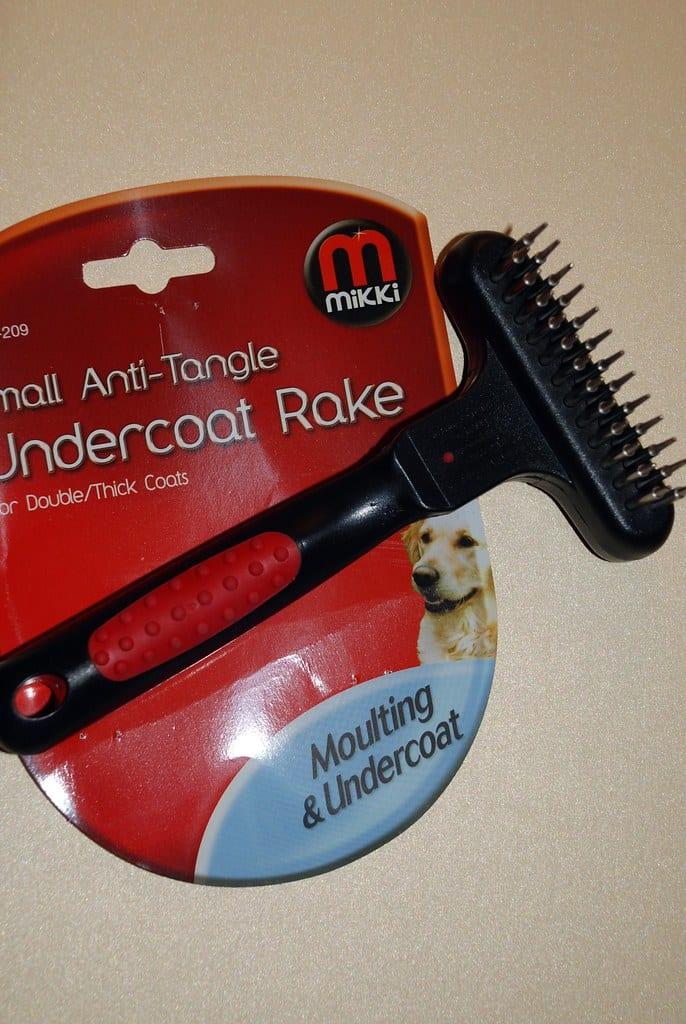
If your dog is a Husky, Samoyed, Great Pyrenees or a long-coated German Shepherd, this comparison is the wrong one to be reading: both blade-edge tools are designed to work at or near the surface, and a thick double coat needs tines long enough to pass through the guard layer and lift undercoat from underneath it. A rake does that without cutting anything, which is why it is the standard answer on the breeds that shed in sheets.
Undercoat reach9.5
Volume removed per session9.0
Gentleness on guard coat9.0
Works on long coats9.0
Value9.0
Overall9.1 / 10
What it gets right
+Rotating tines slide through dense undercoat instead of ripping it, so the dog tolerates longer sessions
+Reaches deeper into a double coat than any slicker
+Does not cut, so you cannot thin the guard coat with it
What it gets wrong
−Slower than a bladed deshedder on short coats
−Tines can catch on a genuine mat and need working loose
−Does not finish — you still need a slicker and comb afterwards
Who should skip itSkip it on a short-coated dog — a bladed deshedder does that job far faster.
#adHow we earn · We never print a price we cannot verify
FAQ
Questions people actually ask
+−Is the SleekEZ better than the FURminator?
Better for different things. The SleekEZ is gentler and better for frequent light maintenance and slick coats; the FURminator removes far more hair per session because it reaches undercoat the SleekEZ never touches. If your dog has a real undercoat, the FURminator does more. If it does not, the FURminator has nothing to find.
+−Can you use a FURminator on a long-haired dog?
Only the long-hair variant, and only on a coat that is already combed out and free of mats. On a genuinely deep double coat the tool cannot reach the bottom layer, so a rake with long tines does the job better. On a matting coat such as a doodle it is the wrong tool entirely.
+−How often should you use a deshedding tool?
A surface tool such as the SleekEZ can be used weekly or twice weekly. A deep bladed tool such as the FURminator belongs on a monthly rhythm, stepped up to weekly only while the coat is actively blowing. Daily use of a bladed deshedder thins the coat.
+−Do I need both?
No, but they do layer well on a short double coat: the shallow tool weekly, the deep tool monthly or during a coat drop. If you are only buying one, buy by coat depth — undercoat you cannot reach means the FURminator, surface hair means the SleekEZ, and a thick double coat means neither.
How this page was put together
We define the coat problem the tool has to solve, shortlist products currently sold, compare the manufacturers’ documented specifications against what that coat actually needs, and cross-check against published findings from named sources. We do not test these tools on our own dogs under controlled conditions, and we will not say we do. Where a figure comes from a manufacturer, we name them; where it comes from someone else’s testing, we cite them. We print no prices — a stale number is worse than none. Read the full method.