Scores are our own editorial assessment, not a product rating from reviews or testing. We do not print prices — every button goes to the current one on Amazon. #ad
Which coat are you dealing with?
The short answer
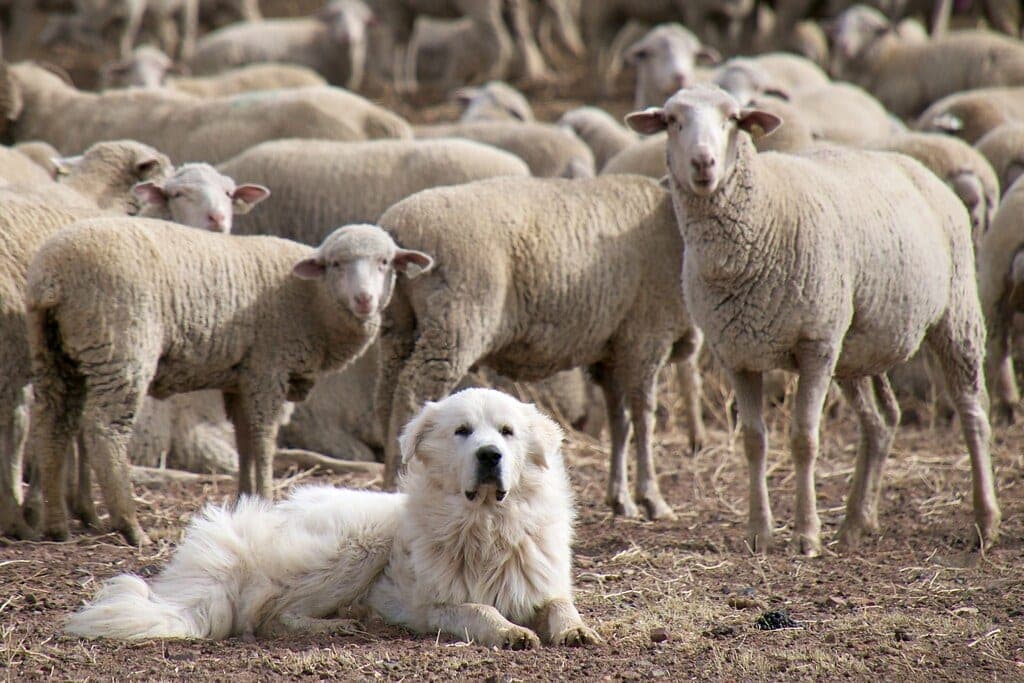
A Great Pyrenees has a very large, weather-resistant double coat. Rake weekly in sections, dry thoroughly after any bath, and manage the session rather than the coat: a dog this size will stand for a limited time, so split the work across days. Never shave it.
A Great Pyrenees has a double coat — harsh guard hairs over soft undercoat; sheds in sheets, never shave it. Everything below follows from that, and the full set of rules for this coat type, including what will damage it, is on grooming a double coat.
Pyrenees coat is a long, coarse, weather-resistant outer coat over a dense woolly undercoat, designed to let a dog sleep outdoors in a mountain winter. It is remarkably self-cleaning and dirt-shedding, and it does not mat in normal use the way a curly coat does.
What makes this breed hard is purely scale. A 90 to 120 lb dog with a long double coat is a lot of square footage, and every task — raking, bathing, drying — takes multiples of what it takes on a medium dog.
Pyrenees also carry a double rear dewclaw, which is breed-typical. Those nails never contact the ground, never wear down, and are the ones most likely to grow into a curl. Check them every single time you do nails.
Great Pyrenees: Harsh guard hairs over soft undercoat; sheds in sheets, never shave it.
The breed-specific thing to watch
Manage the session, not the coat
A dog this size will stand for a limited period before it starts to object, and the limit is usually the dog's patience rather than the coat's condition. Trying to do everything in one go is how both of you end up resenting it.
Work in sections across days: hindquarters and trousers one evening, body another, head and ruff a third. A dog that is always relaxed during grooming is far easier to groom for the next ten years than a dog you got through in one marathon.
The routine
Task
How often
Notes
Rake in sections
Weekly, rotating sections
Ten to fifteen minutes per section
Slicker behind the ears and the ruff
Weekly
The areas that actually mat
Bathe
2-3x a year
A major undertaking; budget a half-day including drying
Dry thoroughly
Every bath
Check at the skin; damp undercoat causes hot spots
Check rear dewclaws
Every nail session
Breed-typical double dewclaws that never wear down
Trim paw pads
Monthly
Large feet with a lot of fur between the pads
Nails
Every 2-3 weeks
Thick nails; clip the bulk, grind the finish
Body clipping
Never
Weather-resistant coat; clipping damages it
Where it goes wrong on this breed
Behind the ears
The ruff and the chest
The trousers on the hind legs
The tail plume
The rear dewclaws, which are easy to forget entirely
Between the pads
Time and effort, honestly
Realistically 40 to 60 minutes of raking a week, best split into sections across several days. A bath and dry is a half-day. There is no clipping, which is the one mercy of the breed.
The coat page is the one to read in full: grooming a double coat. From there the tool roundups cover each purchase in detail, and how to groom a dog at home walks a full session end to end. Other breeds with the same coat are listed on the breed index.
The picks in full
Every pick, in order
01
The purchase that comes before any tool
Flying Pig electric lift grooming table
Nobody grooms a 110 lb dog properly while bent over it on the floor.
On a dog this size the table is not a convenience, it is what makes the job possible at all. A low entry height means the dog walks on instead of being lifted — removing the most likely way either of you gets injured — and the 220 to 400 lb capacity and 42 to 50 inch top are built for exactly this dog. Expensive and it earns it here more than anywhere.
Makes the job possible10.0
Getting the dog on10.0
Capacity9.5
Value5.5
Overall8.6 / 10
What it gets right
+The low entry height is the real feature: a senior or arthritic dog walks on instead of being lifted
+Removes the single biggest injury risk in home grooming, which is you lifting the dog
+Height adjustment mid-groom saves your back on a long session
What it gets wrong
−The most expensive item in this whole category by a wide margin
−Needs a power outlet and a permanent floor footprint
−A motor is one more thing that can fail
Who should skip itSkip it if you own a 15 lb dog you can lift one-handed — you are buying a solution to a problem you do not have.
#adHow we earn · We never print a price we cannot verify
02
Drying and deshedding at this scale
Shernbao High Velocity professional dryer (6.0 HP)
Dual 6.0 HP is not excessive on a soaked Pyrenees. It is the minimum that finishes in time.
Twin-motor high-velocity force dryer
Motors
Dual 6.0 HP
Claimed benefit
Reduces drying time by over 70%
Built for
Busy groomers and large dogs
A soaked Pyrenees holds an enormous amount of water, and a single-motor dryer takes long enough that the dog gives up before the coat is dry. Twin 6.0 HP motors with a claimed 70%-plus time saving bring the session inside the dog's tolerance, and one motor alone is enough for sensitive areas.
Time to dry10.0
Blows undercoat out10.0
Noise4.0
Value6.5
Overall8.4 / 10
What it gets right
+Twin motors mean you can run one for a nervous dog and both for a soaked Newfoundland
+The fastest dry in this set on a genuinely large double coat
+Built for repeat daily use, not occasional home use
What it gets wrong
−The most expensive dryer here and the heaviest
−At full output it is extremely loud
−More dryer than a single-dog household will ever use
Who should skip itSkip it unless you are drying a large double coat regularly — one motor's worth is enough for most homes.
The weekly job on a Pyrenees is a lot of raking, so the tool has to be comfortable for the dog across long sessions and safe against a weather-resistant guard coat. Rotating tines with no cutting edge are both. Buy two and keep one in each room if that is what makes the sections happen.
Reaches undercoat9.0
Guard-coat safety10.0
Comfort over long sessions9.0
Value9.0
Overall9.3 / 10
What it gets right
+Rotating tines slide through dense undercoat instead of ripping it, so the dog tolerates longer sessions
+Reaches deeper into a double coat than any slicker
+Does not cut, so you cannot thin the guard coat with it
What it gets wrong
−Slower than a bladed deshedder on short coats
−Tines can catch on a genuine mat and need working loose
−Does not finish — you still need a slicker and comb afterwards
Who should skip itSkip it on a short-coated dog — a bladed deshedder does that job far faster.
#adHow we earn · We never print a price we cannot verify
FAQ
Questions people actually ask
+−How to trim a Great Pyrenees?
You do not trim the coat. Paw pads, the hair between the pads and a sanitary trim are the only cutting this breed needs. The body coat is raked, never clipped.
+−Can I shave a Great Pyrenees in summer?
No. The coat is a weather barrier in both directions and the guard hairs block sun. A Pyrenees that is hot needs its dead undercoat raked out, shade and water.
+−Do Great Pyrenees need their dewclaws trimmed?
Yes, and they are the nails most often missed. The breed-typical rear double dewclaws never touch the ground, never wear down, and can grow into a curl. Check them every nail session.
+−How often should a Great Pyrenees be bathed?
Two or three times a year. The coat is impressively self-cleaning, and the drying effort makes frequent bathing impractical anyway.
How this page was put together
We define the coat problem the tool has to solve, shortlist products currently sold, compare the manufacturers’ documented specifications against what that coat actually needs, and cross-check against published findings from named sources. We do not test these tools on our own dogs under controlled conditions, and we will not say we do. Where a figure comes from a manufacturer, we name them; where it comes from someone else’s testing, we cite them. We print no prices — a stale number is worse than none. Read the full method.