Skip to content
Clip & Coat

Guides

How to Trim Overgrown Dog Nails

This one cannot be fixed in an afternoon, and the attempt is what hurts dogs. The quick grew out with the nail and has to be persuaded back.

By Brijon M.
An overgrown dog nail alongside a correctly trimmed one

The short answer

The short answer

You cannot shorten an overgrown nail to its correct length in one session, because the quick has grown out with the nail and sits much further forward than it should. Take a small amount every week or two; the quick recedes behind the shortening nail over four to eight weeks, and the nail follows it back.

Why the quick is the limit, not the nail

The quick — the blood vessel and nerve inside the nail — is not at a fixed position. It extends as the nail grows and recedes when the nail is kept short. So in a dog whose nails have been long for months or years, the quick has migrated forward, and the safe cutting point is much further out than on a well-maintained nail.

This has one practical consequence that nothing can shortcut: the first session will leave the nail looking too long, and that is the correct outcome. Keeping it at that length for a week or two signals the quick to recede, which then allows another small amount off. Work with that cycle and the job is painless; work against it and the only way to shorten the nail today is to cut into living tissue.

A realistic timeline

WeekWhat you doWhat you should see
0Clip or grind off the clear excess tip; stop well short of the quickNail still looks long. Correct.
1–2Grind a small amount from each nailQuick has started receding; a little more available
3–4RepeatVisible improvement in the angle of the toes
5–6RepeatNails approaching the toe line
7–8Repeat, then switch to maintenance every 2–3 weeksNails off the floor when standing square

Timeline varies with how overgrown the nails were and how fast the individual dog's nails grow.

Some overgrown nails are past the point where a weekly program is the right first step:

A nail that has curled round and is growing into the pad needs cutting now and it will hurt — that is a vet or a vet nurse, often with sedation. A nail that is cracked, split or bleeding, a paw that is swollen or smells, or a dog that is lame or will not bear weight, all need veterinary attention rather than a trim. And a dog that is in genuine pain when you handle the paw at all is telling you something a nail grinder will not fix.

This page is not veterinary advice. If any of the above describes your dog, make the call.

The method

  1. 01

    Styptic powder in reach, as always

    The margin for error is smaller than usual here because the quick is forward. Have it on the table.

  2. 02

    Session one: take the clear excess only

    On a very long nail there is obvious spare tip. A clipper removes it in one cut, or a grinder in a few bursts. Stop as soon as you are no longer obviously clear.

  3. 03

    Resist finishing the job

    The nail will still look long. That is the correct result of session one and the hardest part of the method to accept.

  4. 04

    Come back in one to two weeks

    Take another small amount. Read the cut face as you go — chalky ring, then the dot, then stop.

  5. 05

    Keep the cycle until the nails clear the floor

    Standing square on a hard surface, no nail touching. That is the target.

  6. 06

    Switch to maintenance

    Every two to three weeks thereafter. Maintenance is trivially easy compared with recovery, which is the argument for never letting it slide again.

A paw being held while a nail is ground back in small increments
Small amounts, weekly. The nail's length is limited by the quick, and the quick moves on its own schedule.

What overgrown nails do to a dog

Long nails hit the floor before the pad does, which pushes the toes up and back and changes the dog’s whole stance. Over months that loads the toe joints in a direction they are not built for, and it is a common hidden contributor to reluctance to walk on hard floors and to a splay-footed stance in older dogs. It is also why dogs sometimes become noticeably happier moving around after a nail program — the change is mechanical, not cosmetic.

What to remember

  • An overgrown nail has an overgrown quick. One session cannot fix it.
  • Take a small amount every one to two weeks; the quick recedes behind it.
  • Expect four to eight weeks. The first session will leave nails looking long.
  • A nail curling into the pad, bleeding, or a lame dog: vet, not grinder.
  • Target: no nail touching the floor with the dog standing square.
  • Then maintain every two to three weeks — maintenance is far easier than recovery.

The picks in full

Every pick, in order

01

Weekly small increments over several weeks

Dremel PawControl 7760-PGK

The only practical tool for taking a millimeter at a time, every week, without drama.
A cordless rotary tool of the kind used to grind dog nails

Cordless variable-speed nail grinder

Speed range
8,000 – 25,000 RPM
Power
Cordless, rechargeable
Torque
More than most budget pet grinders
Best for
Medium and large dogs, thick nails

Specs: Dogster — Best Dog Nail Grinders

The whole method here is many tiny removals, and that is what a grinder does and a clipper does not. Enough torque for the thick nails that overgrowth usually comes with, and the guard stops a beginner taking more than intended. Over a six-week program the per-session gentleness matters far more than speed.

Control near the quick9.5
Thick-nail capability9.0
Suitability for this method9.5
Noise and vibration6.5
Value7.0
Overall8.5 / 10

What it gets right

  • It is a Dremel rotary tool, so it has torque a pet-branded grinder does not — thick nails do not stall it
  • The speed range means you can start slow on a dog that hates the noise
  • Grinds rather than crushes, so there is no split-nail risk

What it gets wrong

  • At 25,000 RPM it generates heat fast; you must pulse, not dwell
  • Louder and more vibration than a low-RPM pet grinder
  • Guard attachment is fiddly and most people stop using it

Who should skip itSkip it for a tiny, noise-phobic dog — the RPM and vibration are more than the job needs.

Check price on Amazon

#ad How we earn · We never print a price we cannot verify
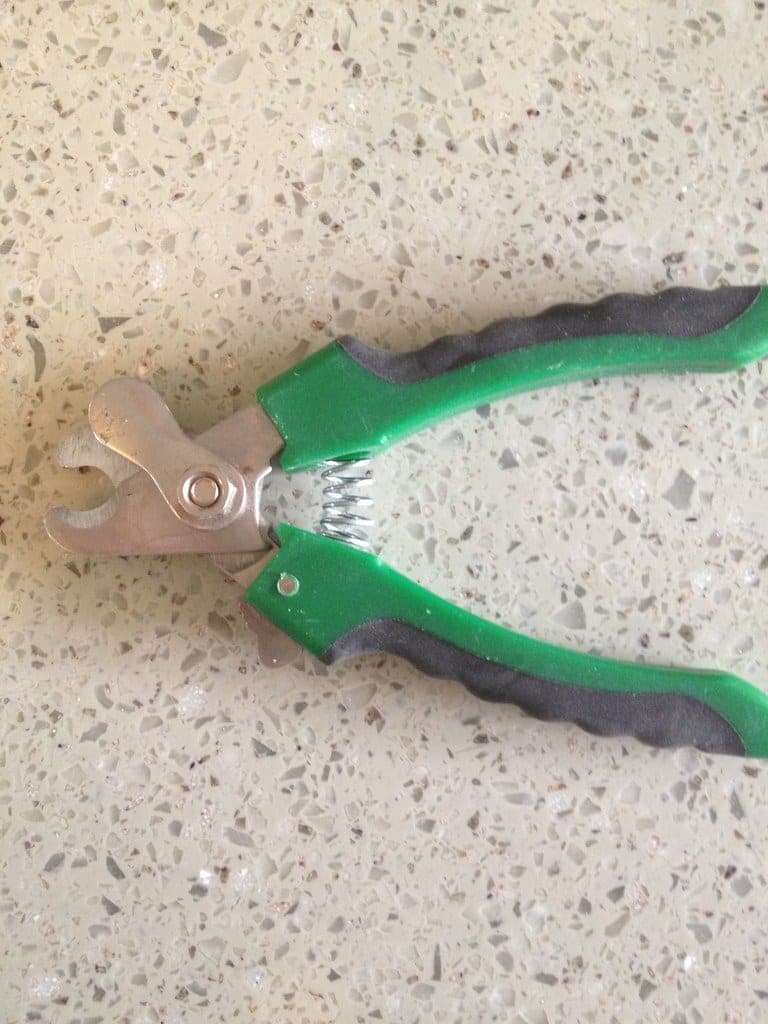
02

Taking the first bulk off a very long nail

Safari Professional nail trimmer

A strong scissor-type clipper for the initial tip removal, where there is clearly spare nail.

Scissor-style nail clippers for dogs

Plier-style nail clipper with safety stop

Safety stop
Yes — limits cut depth
Blades
Double blade with tension spring
Material
Stainless steel, non-slip handle

Specs: Dogster — Best Dog Nail Clippers for Thick Nails

On a severely overgrown nail the outer portion is well clear of the quick and a clipper removes it in one quick cut, which saves a lot of grinding. That first cut is the one place a clipper beats a grinder in this program. After it, switch to grinding for everything near the quick.

Sharpness9.0
Thick-nail capability8.5
Speed9.0
Control near the quick6.0
Value9.0
Overall8.3 / 10

What it gets right

  • The safety stop is the single most useful feature for a first-timer worried about the quick
  • The tension spring makes the cut more accurate rather than just easier
  • Double blade shears from both sides, so the nail does not crush

What it gets wrong

  • The safety stop limits how much you can take off a badly overgrown nail
  • Spring tension is firm for small hands
  • Not as sharp out of the box as a Millers Forge

Who should skip itSkip it if you are confident with the quick — the stop will slow you down.

Check price on Amazon

#ad How we earn · We never print a price we cannot verify

FAQ

Questions people actually ask

Can a vet just cut them all short under sedation?

Yes, and for severely overgrown nails that is sometimes the kindest route — the quicks can be cut back and cauterized in one go while the dog is asleep. It is a genuine option worth discussing rather than a failure, especially for a dog that will not tolerate a weekly program.

How do I know the quick is receding?

Each session you will find a little more nail available before the chalky ring and the dot appear. That extra margin is the quick having moved back. If you get no extra margin after two or three sessions, leave longer between them.

Should I file the nails every few days instead?

Light grinding every few days works and some owners prefer it — the increments are smaller and the dog habituates faster. The one thing to avoid is grinding the same nail repeatedly in one sitting, because friction heat travels to the quick.

How this page was put together

We define the coat problem the tool has to solve, shortlist products currently sold, compare the manufacturers’ documented specifications against what that coat actually needs, and cross-check against published findings from named sources. We do not test these tools on our own dogs under controlled conditions, and we will not say we do. Where a figure comes from a manufacturer, we name them; where it comes from someone else’s testing, we cite them. We print no prices — a stale number is worse than none. Read the full method.

Sources

  1. 01Whole Dog Journal — the best dog nail grinders
  2. 02Dogster — best dog nail clippers for thick nails